Variety of delivery options including next day & free delivery.
Pharmacy, clinic and prescribers based in Greater Manchester.
Start your treatment with a quick and free online consultation.
Variety of delivery options including next day & free delivery.
Pharmacy, clinic and prescribers based in Greater Manchester.
Start your treatment with a quick and free online consultation.
Fill in a quick online consultation for our licensed pharmacists to review.
Our pharmacists will review your treatment to ensure it’s suitable.
Your treatment will be delivered to your door quickly & discreetly.
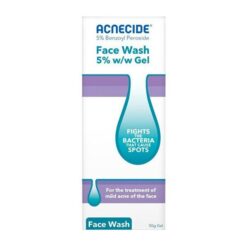
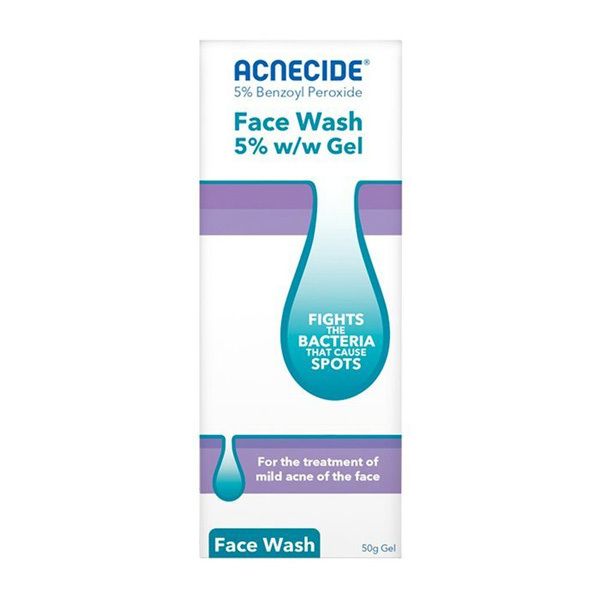
| Medication Name | Acnecide Face Wash 5% w/w Gel |
| Medication Form | Topical gel |
| Pack Size | 50g and 100g |
| Used For | Treatment of mild acne on the face |
| Who Can Use It | Adults and adolescents aged 12 and over |
| Active Ingredient | Benzoyl peroxide 5% |
| Usual Dose | Apply once or twice daily to affected areas of the face |
| Common Side Effects | Dry skin, skin redness, peeling, burning sensation |
| Prescription Required | No |
| Patient Information Leaflet | Acnecide Face Wash Patient Information Leaflet |
Acnecide Benzoyl Peroxide Face Wash is an acne treatment for mild facial acne in adults and adolescents aged 12 and over.
Mild acne typically appears as blackheads and whiteheads, with few or no spots, pimples or inflamed areas.
If your acne is more severe, involves inflamed spots or larger lumps, or has left scarring, Acnecide Face Wash isn’t the right treatment for mild acne and you should speak to your pharmacist or doctor.
Acnecide isn’t intended for acne on the shoulders, back or chest.
Acnecide Face Wash 5% contains the active ingredient benzoyl peroxide, an antibacterial ingredient that works by killing the bacteria responsible for acne. The bacteria it targets, Propionibacterium acnes, is one of the main causes of acne.
Benzoyl peroxide works directly on the skin’s surface. Because Acnecide is only absorbed into the body in very small amounts, it has little effect beyond the area it’s applied.
Acnecide 5% face wash is suitable for adults and adolescents aged 12 and over with mild acne of the face.
Don’t use Acnecide Face Wash if you:
Talk to your doctor or pharmacist before using Acnecide if you’re pregnant or breastfeeding. If you’re breastfeeding, don’t apply the gel to your chest unless advised by your doctor, to avoid your baby coming into contact with it.
Acnecide Face Wash Gel is for external use on the face only. Follow these steps each time you use it:
When you first start treatment, use Acnecide once daily on the affected areas of your face before going to bed. You may notice some mild burning and slight reddening or peeling of the skin during the first few days; this is normal. If you have no reaction after 2 to 3 days, you can increase to twice daily to cover the affected skin areas, applying in the morning and evening.
If you experience more severe redness, burning, irritation or peeling at any point, stop treatment and allow your skin to return to normal before restarting. If irritation continues after stopping, speak to your pharmacist or doctor.
Using a moisturiser after application can help reduce any irritation.
Like all medicines, Acnecide Face Wash can cause side effects, though not everyone gets them. Most side effects affect the skin at the site of application and are usually reversible if the frequency of use is reduced or treatment is stopped.
Stop using Acnecide and tell your doctor immediately if you develop signs of a severe allergic reaction, including a raised and itchy rash (hives), swelling of the face, eyes, lips, tongue or mouth, difficulty breathing, or fainting.
If you notice any side effects not listed here, tell your pharmacist or doctor. You can also report side effects directly via the Yellow Card Scheme.
Active ingredient: Benzoyl peroxide 5% w/w (as hydrous benzoyl peroxide gel)
Other ingredients: Acrylates copolymer, glycerol, carbomer 940, sodium C12–C14 olefin sulfonate, sodium hydroxide (for pH adjustment) and purified water.
GOOD Based on 184 reviews
 Posted on Google
 Bradley Robinson30/04/2026
 Absolutely Amazing staff! Such a help thank you so muchPosted on Google
 Samiur Rahman30/04/2026Best pharmacy in the UK. The staff here are very helpful, empathetic, understanding and compassionate. Brilliant customer service and staff are actual people who use their discretion to help people.Posted on Google
 Vivien donnellon29/04/2026Extremely efficient and knowledgeable information given. All my questions were answered and also some advise regarding the issue. Thank you RehanaPosted on Google
 james watkins22/04/2026Brilliant device ordered yesterday received it today
There’s no fixed timeframe; it depends on how quickly your skin responds. If things haven’t improved after 12 weeks, see your pharmacist or doctor, as an alternative treatment may be more suitable.
How long you’ll need to use Acnecide depends on how quickly your condition improves. If your acne gets worse while using Acnecide or doesn’t improve within 12 weeks, see your pharmacist or doctor. Undertreatment of some forms of acne may sometimes result in scarring, and your doctor will be able to recommend an alternative treatment for your acne.
Acnecide Face Wash is a wash-off treatment for mild acne, not a regular cleanser. It can also be used as a spot treatment for targeted areas. The contact time with the skin allows the benzoyl peroxide to work on acne-causing bacteria before rinsing. It isn’t intended as a substitute for your everyday face wash.
Both contain 5% benzoyl peroxide, but they work differently. Acnecide Face Wash is a wash-off treatment for mild acne on the face only. Acnecide Gel is a leave-on treatment suitable for mild to moderate acne on the face, chest and back. If you’re unsure which is right for you, speak to your pharmacist.
Acnecide Face Wash and Acnecide Gel both contain benzoyl peroxide, so using them together isn’t recommended unless your doctor has specifically advised it. Using two benzoyl peroxide products at the same time increases the risk of skin irritation.
Acnecide can bleach or discolour anything it comes into contact with, including towels, pillowcases and clothing. Using white or light-coloured towels and bedding while on treatment is a sensible precaution.
Page content authored by Amjad Khan, last reviewed by Mr Muhammad on 8th August 2026.