Royal Mail tracked 24 or 48 hour delivery in plain, unmarked packaging.
Pharmacy, clinic and prescribers based in Greater Manchester.
Where a prescription is needed, the price you see includes your consultation and prescription.
Royal Mail tracked 24 or 48 hour delivery in plain, unmarked packaging.
Pharmacy, clinic and prescribers based in Greater Manchester.
Where a prescription is needed, the price you see includes your consultation and prescription.
Fill in a quick online consultation for our licensed pharmacists to review.
Our pharmacists will review your treatment to ensure it’s suitable.
Your treatment will be delivered to your door quickly & discreetly.
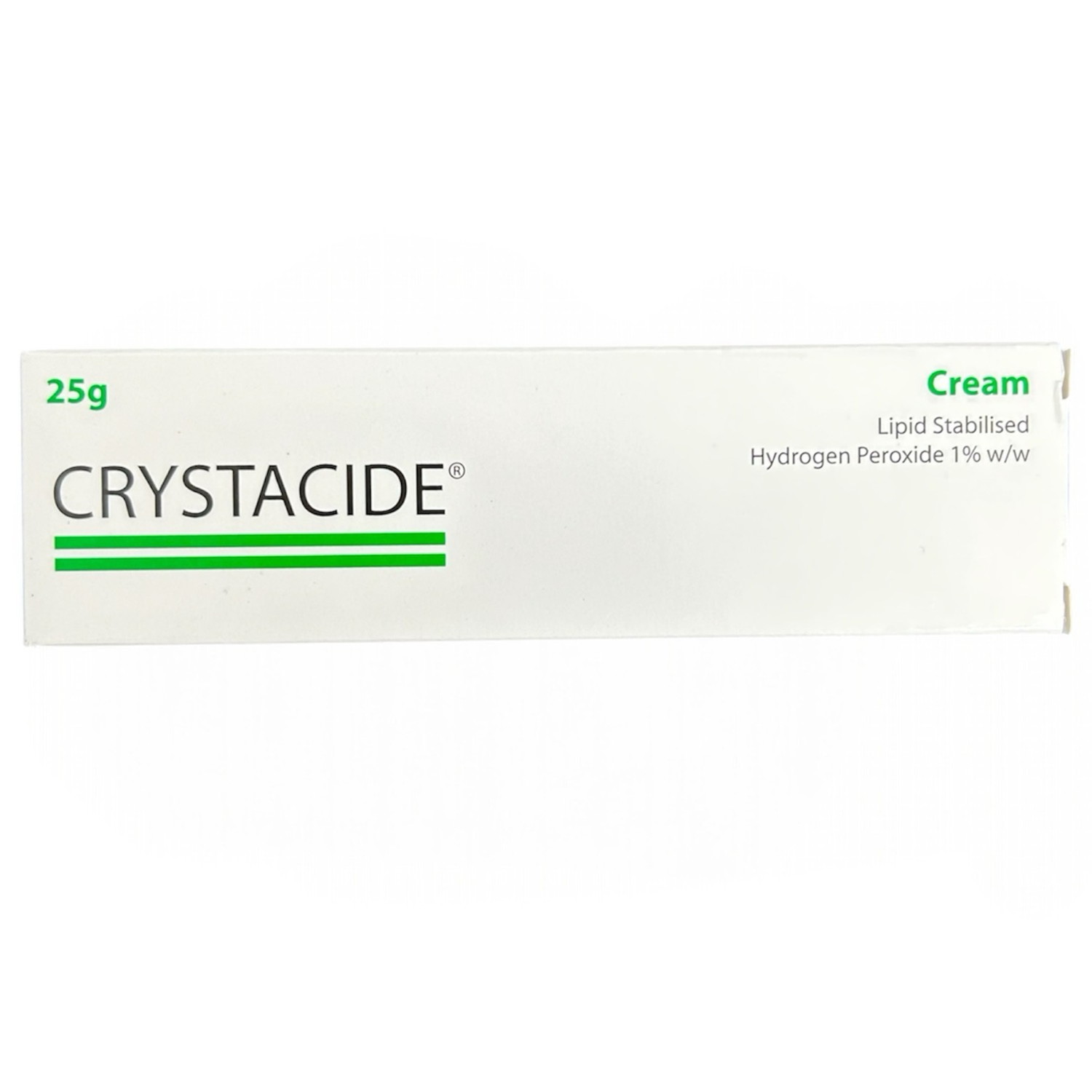
| Medication Name | Crystacide 1% w/w Cream |
| Medication Form | Lipid-stabilised topical cream |
| Used for | Superficial skin infections, including impetigo |
| Who can use | Adults and children |
| Active Ingredient(s) | Hydrogen peroxide 1% w/w |
| Usual Dose | Apply 2 to 3 times a day to the affected area |
| Common Side Effects | Mild burning sensation after application |
| Prescription Required | No, Pharmacy (P) medicine sold under pharmacist supervision |
| Patient Information Leaflet | Crystacide Cream Patient Information Leaflet |
Crystacide Cream 1% is a topical treatment for skin infections caused by micro-organisms sensitive to hydrogen peroxide. Crystacide cream uses include treating primary and secondary skin infections, such as impetigo, from infections on healthy skin to infected cuts, grazes or spots.
Impetigo is a highly contagious bacterial skin infection that most commonly affects the face, hands and around the nose and mouth. It causes sores or blisters that burst and form a golden crust. Because it spreads easily through direct contact, you should start treatment as soon as possible.
Crystacide is applied directly to the infected area, where it works to clear the infection and reduce the risk of it spreading further.
Crystacide cream works using hydrogen peroxide, a potent antiseptic that’s active against many types of bacteria, along with some fungal infections and viruses. It works by destroying the cell walls of these organisms, which allows the infection to clear, though it’s most commonly used for bacterial skin infections like impetigo.
The cream’s lipid-stabilised formulation keeps the hydrogen peroxide active on the skin for longer than a standard hydrogen peroxide solution. This gives it a sustained effect between applications.
Crystacide cream is suitable for adults and children with primary or secondary superficial skin infections.
Don’t use Crystacide cream if you:
Crystacide shouldn’t be applied to healthy skin, only to the affected area.
Speak to healthcare professionals before using Crystacide cream if you:
Don’t use Crystacide cream continuously for more than 3 weeks. If your symptoms don’t improve, consult your doctor.
Like all medicines, Crystacide cream can cause side effects, though not everyone gets them. It’s generally well tolerated and isn’t associated with any serious side effects.
The following side effects have been reported, though how often they occur isn’t known:
Some of the other ingredients in Crystacide can also cause reactions in a small number of people:
If your skin remains irritated for a long time, or you notice any side effects not listed here, tell your doctor or pharmacist. You can also report side effects directly through the Yellow Card Scheme.
Active ingredient: Hydrogen peroxide 1% w/w
Other ingredients: Glyceryl monolaurate, glyceryl monomyristate, macrogol stearate 5000, propylene glycol, anhydrous citric acid, sodium hydroxide, sulphuric acid, sodium oxalate, salicylic acid, disodium edetate, sodium pyrophosphate, sodium stannate and purified water
GOOD Based on 184 reviews
 Posted on Google
 Bradley Robinson30/04/2026
 Absolutely Amazing staff! Such a help thank you so muchPosted on Google
 Samiur Rahman30/04/2026Best pharmacy in the UK. The staff here are very helpful, empathetic, understanding and compassionate. Brilliant customer service and staff are actual people who use their discretion to help people.Posted on Google
 Vivien donnellon29/04/2026Extremely efficient and knowledgeable information given. All my questions were answered and also some advise regarding the issue. Thank you RehanaPosted on Google
 james watkins22/04/2026Brilliant device ordered yesterday received it today
Crystacide is recommended by NICE as a first-line treatment for localised, non-bullous impetigo in people who aren’t otherwise unwell. Evidence shows it clears infection as effectively as a topical antibiotic when used as directed. You must complete the full course rather than stopping as soon as your skin looks better, to help prevent the infection from coming back.
If you forget an application, just apply it as soon as you remember and carry on as before. There’s no need to double up or apply extra to make up for a missed one.
Open wounds and superficial infections are treated differently. Crystacide is designed for surface-level infections, such as impetigo and infected cuts, grazes or spots, rather than open or deep wounds, which usually need different wound care. If you’re not sure whether Crystacide is right for your wound, a pharmacist can take a look before you start treatment.
There’s no specific age restriction on Crystacide cream, which is why it’s often used across a household when more than one person has been diagnosed with the same infection, such as impetigo. If you’re not sure it’s the right choice for you or your child, check with a pharmacist before starting treatment.
Other options for treating superficial skin infections include topical antibiotic creams, such as fusidic acid, which a doctor may prescribe if a hydrogen peroxide-based cream isn’t suitable. The right choice depends on the type and severity of the infection, so it’s worth discussing with your doctor or pharmacist.
Crystacide is only licensed for surface-level infections sensitive to hydrogen peroxide. It isn’t suitable for conditions like fungal nail infections, cold sores or infections that go deeper than the surface of the skin. If you’re dealing with something else, a pharmacist can point you towards a more suitable product.
Page content authored by Amjad Khan, last reviewed by Mr Muhammad on 18th August 2026.