Royal Mail tracked 24 or 48 hour delivery in plain, unmarked packaging.
Pharmacy, clinic and prescribers based in Greater Manchester.
Where a prescription is needed, the price you see includes your consultation and prescription.
Royal Mail tracked 24 or 48 hour delivery in plain, unmarked packaging.
Pharmacy, clinic and prescribers based in Greater Manchester.
Where a prescription is needed, the price you see includes your consultation and prescription.
Fill in a quick online consultation for our licensed pharmacists to review.
Our pharmacists will review your treatment to ensure it’s suitable.
Your treatment will be delivered to your door quickly & discreetly.
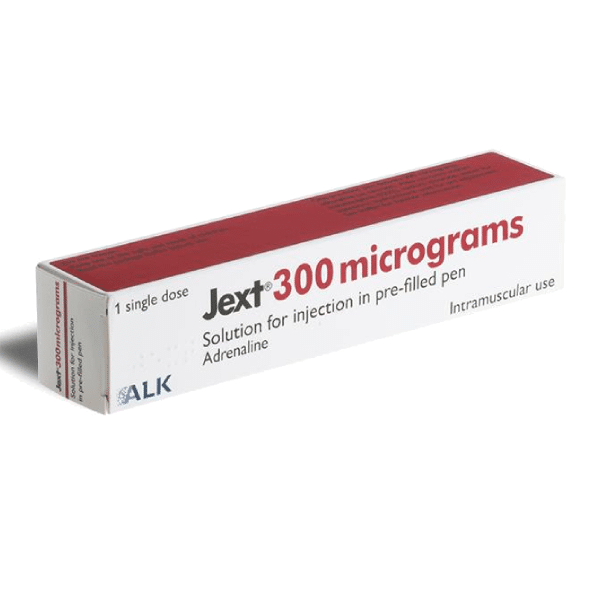
| Medication Name | Jext 300 micrograms |
| Medication Form | Solution for injection in a pre-filled pen |
| Used for | Emergency treatment of severe allergic reactions (anaphylaxis) |
| Who can use | Adults and children weighing over 30kg |
| Active Ingredient(s) | Adrenaline (as tartrate) |
| Usual Dose | One 300 microgram injection into the outer thigh muscle |
| Possible Side Effects | Tremor, headache, dizziness, sweating, nausea, a fast or irregular heartbeat |
| Prescription Required | Yes |
| Patient Information Leaflet | Jext 300 Micrograms Patient Information Leaflet |
Jext is used for the emergency treatment of anaphylaxis, a sudden, life-threatening allergic reaction. It can be triggered by:
Symptoms of anaphylaxis usually start within minutes of coming into contact with the trigger. They can include:
Jext isn’t a treatment you take day to day. A Jext adrenaline pen is carried with you so it’s there the moment you need it.
Jext contains adrenaline, a hormone your body produces naturally. During anaphylaxis, the immune system overreacts to a trigger, such as a food or a sting, and releases chemicals that widen the blood vessels, cause low blood pressure and narrow the airways.
Injecting adrenaline into the thigh muscle reverses those changes. It tightens the blood vessels to bring blood pressure back up, relaxes the muscles in the airways to make breathing easier and reduces swelling.
Adrenaline auto-injectors are designed for one use only. Each Jext pen delivers a single 300 microgram dose, and some liquid is left behind in the injector afterwards, but it can’t be used again.
Jext 300 micrograms is prescribed for adults and children who weigh more than 30kg. Children between 15kg and 30kg are prescribed the lower 150 microgram strength instead, so the dose will need reviewing with your doctor as your child grows.
Jext can always be used during an allergic emergency, even if you’re allergic to one of the ingredients, because anaphylaxis is the bigger danger. Your doctor will talk you through this when it’s prescribed.
Speak to your doctor when you’re prescribed Jext if you have:
Tell your doctor if you’re elderly or pregnant, or if the child being prescribed Jext weighs less than 15kg, as there’s a greater risk of side effects. If you have asthma, you may be at greater risk of anaphylaxis.
Jext is pushed firmly against the thigh and works through clothing, so use it the moment you notice signs of anaphylaxis. If you’re in doubt, use it.
Only remove the yellow cap when you’re ready to inject, and never put your thumb, hand or feet over the black injector tip, as that’s where the needle comes out.
A white plastic rod appears in the inspection window to confirm the injection has been delivered. Always go to hospital for observation afterwards, and let the healthcare professional treating you know you’ve had an intramuscular injection of adrenaline.
Always carry two Jext pens with you, as one dose isn’t always enough. If you have a thick layer of fat under the skin in particular, a second injection may be needed.
Your doctor or nurse should talk you through the signs of anaphylaxis and how to administer Jext before you ever need it. Take your pen along to an appointment or into your local pharmacy and ask someone to run through it with you. It’s worth family members, carers or teachers being shown as well, since they may be the ones giving the injection. Trainer pens, which hold no needle or medicine, are available from the manufacturer so you can practise.
Like all medicines, Jext can cause side effects, although not everybody gets them.
Side effects reported with adrenaline include:
Jext contains an ingredient called sodium metabisulphite. In rare cases, this can trigger a severe allergic reaction or difficulty breathing.
Accidental injection into the hands, fingers, feet or toes can reduce the blood supply to those areas, causing coldness, paleness, tingling, numbness, bruising, pain, bleeding and swelling. Go straight to your nearest hospital emergency department if this happens.
If you get any side effects, talk to your doctor or pharmacist. You can also report them directly through the MHRA Yellow Card Scheme.
Active ingredient: adrenaline (as tartrate). Jext 300 micrograms injects a single dose of 300 micrograms of adrenaline as a 0.3ml solution for injection.
Other ingredients: sodium chloride, sodium metabisulphite (E223), hydrochloric acid, water for injections.
GOOD Based on 184 reviews
 Posted on Google

 Bradley Robinson30/04/2026
 Absolutely Amazing staff! Such a help thank you so muchPosted on Google
 Samiur Rahman30/04/2026Best pharmacy in the UK. The staff here are very helpful, empathetic, understanding and compassionate. Brilliant customer service and staff are actual people who use their discretion to help people.Posted on Google
 Vivien donnellon29/04/2026Extremely efficient and knowledgeable information given. All my questions were answered and also some advise regarding the issue. Thank you RehanaPosted on Google
 james watkins22/04/2026Brilliant device ordered yesterday received it today
Both pens contain adrenaline and both treat anaphylaxis by injecting a single dose into the outer thigh muscle, so there’s no difference in the medicine itself. They’re made by different manufacturers, and the devices are held and fired differently, which is why a Jext epipen isn’t one product you can order. If you switch from one brand to the other, get familiar with the new device before you need it.
The safety cap at the top of the pen is yellow and the injector tip at the bottom is black. The colours make it easy to work out which end goes against your thigh when you’re under pressure. Jext 150 and Jext 300 look the same from the outside, so check the strength on the label rather than going by colour alone.
Store it below 25°C and don’t freeze it, keeping it in its plastic carry case when you’re carrying it around. Check the solution through the window now and again, and replace the pen if the liquid looks discoloured or has solid particles in it, or if it reaches its expiry date.
A used pen is best handed to the healthcare team treating you so they can dispose of it safely. Never put medicines in your household bin or down the sink.
Call 999 and say anaphylaxis, then lie down with your legs raised while you wait. Tell the ambulance crew you’ve had an intramuscular injection of adrenaline and hand them the used pen. Expect to stay in hospital for observation, as the reaction can come back hours later. Order a replacement pen as soon as you’re able to, so you always have two with you.
Use Jext as soon as you notice signs of a reaction rather than waiting to see if symptoms settle on their own. The 5-minute mark is your checkpoint: if you haven’t improved by then, you or the person with you should give a second injection. Call 999 straight after the first injection, not after the second.
Fill in a short online consultation with a UK-registered pharmacy team covering your allergy history, symptoms and any other medicines you take. One of our pharmacists reviews your answers to check if the treatment is suitable for you, then you can order online and have it dispatched discreetly to your door. You’ll still need to be shown how to use the device properly, so ask your doctor, nurse or local pharmacist to run through it with you before you start carrying it.
Page content authored by Amjad Khan, last reviewed by Mr Mohammed on 12th October 2026.