Variety of delivery options including next day & free delivery.
Pharmacy, clinic and prescribers based in Greater Manchester.
Start your treatment with a quick and free online consultation.
Variety of delivery options including next day & free delivery.
Pharmacy, clinic and prescribers based in Greater Manchester.
Start your treatment with a quick and free online consultation.
Fill in a quick online consultation for our licensed pharmacists to review.
Our pharmacists will review your treatment to ensure it’s suitable.
Your treatment will be delivered to your door quickly & discreetly.
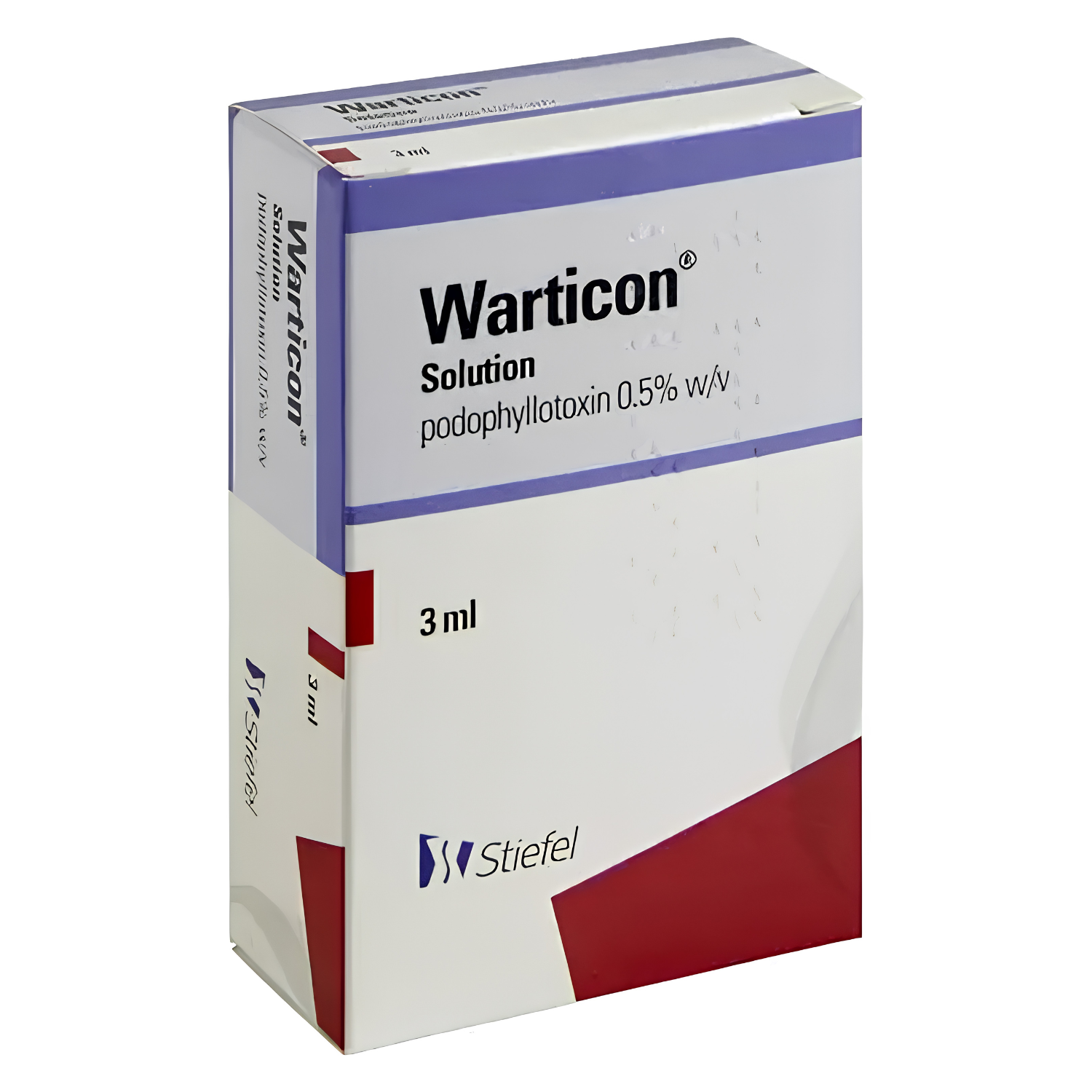
| Medication Name | Warticon cream & Warticon solution |
| Medication Form | Topical cream & cutaneous solution |
| Used for | Treats external genital warts |
| Who can use | Adults aged 18 years and over |
| Active Ingredients | Warticon cream: podophyllotoxin 0.15% w/w
Warticon solution: podophyllotoxin 0.5% w/v |
| Size | Cream: 5g tube
Solution: bottle with double-ended applicators |
| Usual Dose | Apply twice a day for 3 days, then 4 days without treatment |
| Common Side Effects | Wearing away of the top layers of skin, redness, itching, burning sensation at the application site |
| Prescription Required | Yes |
| Patient Information Leaflet | Warticon Cream Patient Information Leaflet |
Warticon is used to treat genital warts, which are caused by the human papillomavirus (HPV). Both the cream and the solution are used to treat genital warts, applied directly to the wart rather than taken by mouth.
There’s a small difference in where each one is used:
Both are for external skin only. Neither should be applied to warts inside the penis, vagina or rectum.
The active ingredient in Warticon is podophyllotoxin, a plant extract that belongs to a group of medicines called antivirals. Each product contains the active ingredient podophyllotoxin as a topical treatment, meaning it acts on the wart tissue where it’s applied rather than working throughout the body.
Treatment runs in courses, with 3 days of application followed by 4 days off, so the skin has time to settle. After two or three days, you may notice mild irritation of the treated area, which shows the treatment is starting to work.
Genital warts are contagious and can be passed to or from a sexual partner, so treating them is only one part of managing them.
| Feature | Warticon Cream | Warticon Solution |
| Strength | Podophyllotoxin 0.15% w/w | Podophyllotoxin 0.5% w/v |
| Texture | White cream | Clear liquid |
| Applied with | A fingertip | A double-ended applicator |
| Pack | 5g tube | Bottle plus a tub of applicators |
| Used for | Warts on the penis in men, external vaginal warts in women | Warts on the foreskin in men, external vaginal warts in females |
| Flammable | No | Yes, avoid flames and smoking while applying |
| Storage | No special storage conditions | Store below 25°C, away from heat and sunlight |
When you’re weighing up between the two, the cream is often easier if you’re treating warts by hand or in areas that are harder to reach with an applicator. Both treatment options follow the same course. The solution has a loop end for separate warts and a spatula end for larger warts or several warts close together, which some people find more precise.
Our pharmacists will help you decide if a solution or cream suits you better during your consultation.
Warticon cream and Warticon solution are for adults aged 18 years and over. Neither is recommended for children under 18, as use in this age group hasn’t been established.
Don’t use Warticon if you:
Our online doctor service and pharmacy team will check if Warticon is suitable for you before you start your treatment. Speak to your doctor before starting if your warts cover an area bigger than 4 centimetres, roughly the size of a postage stamp. You may need to have the treatment applied by a doctor or nurse in a clinic.
Warticon isn’t recommended during pregnancy or while breastfeeding. Use a reliable method of contraception while you’re using it, and tell your doctor if you become pregnant during treatment.
Apply Warticon twice a day, in the morning and evening, roughly every 12 hours for 3 days. Then don’t apply anything for the next 4 days. That completes one treatment course.
If any warts remain 7 days after you started, repeat the course. A maximum of 4 courses may be applied. If warts are still there after 4 courses, see your doctor.
Warticon solution is flammable, so avoid smoking or being near an open flame while you’re applying it and straight afterwards.
Don’t cover the treated area with a plaster or dressing, and avoid getting either product in your eyes. If you do, rinse immediately with plenty of water and see a doctor.
It’s best to avoid sex during treatment and to wait until your warts have gone and your skin has healed. If you do have sex, use a condom to help prevent the spread of genital warts and to protect your partner from contact with podophyllotoxin, which is an irritant.
Like all medicines, Warticon cream and Warticon solution can cause side effects, though not everybody gets them. The cream may cause a reaction where it’s applied, and the possible side effects below are grouped by how often they happen.
These may affect more than 1 in 10 people:
The frequency of these can’t be estimated from the available data. They occur on the area of skin where the treatment is used:
Stop using Warticon and seek medical attention if you get severe burning, stinging, pain, bleeding, itching or swelling of the treated skin. Wash it off your skin immediately with soap and water, and contact your doctor.
If you notice any side effects of Warticon, tell your doctor or pharmacist, even if they aren’t listed here. You can also report side effects through the Yellow Card Scheme. Reporting helps to improve the understanding of this medicine’s safety.
Warticon contains podophyllotoxin as its active ingredient, alongside the other ingredients listed below.
GOOD Based on 184 reviews
 Posted on Google
 Bradley Robinson30/04/2026
 Absolutely Amazing staff! Such a help thank you so muchPosted on Google
 Samiur Rahman30/04/2026Best pharmacy in the UK. The staff here are very helpful, empathetic, understanding and compassionate. Brilliant customer service and staff are actual people who use their discretion to help people.Posted on Google
 Vivien donnellon29/04/2026Extremely efficient and knowledgeable information given. All my questions were answered and also some advise regarding the issue. Thank you RehanaPosted on Google
 james watkins22/04/2026Brilliant device ordered yesterday received it today
Mild irritation of the treated area two or three days after your first use of the cream is a normal sign that it works. One course runs over a week, with 3 days of treatment followed by 4 days off. If any warts remain 7 days after you started, the course can be repeated.
Apply it as soon as you remember. If it’s nearly time for your next dose, wait until then. Don’t use a double dose to make up for a missed one.
Wash it from the treated area immediately and see a doctor. If any gets into your mouth, rinse at once with water. If you swallow some, go to your doctor or hospital straight away and take the tube or bottle with you so they know what you’ve taken.
Warticon wart treatment is prescription-only, so you can’t buy it over the counter. Warticon is available from Click2Pharmacy, a UK-registered online pharmacy, and you can buy Warticon cream online once a pharmacist has confirmed it’s suitable. Complete a short consultation and we’ll review your answers.
It’s best to avoid sex during treatment and to wait until your warts have gone and your skin has healed. Genital warts are contagious and can be passed between partners. If you do have sex, use a condom to help prevent the spread and protect your partner from contact with podophyllotoxin, which is an irritant.
There’s no known interaction between alcohol and Warticon. Warticon is applied to the skin rather than taken by mouth, so drinking won’t affect how your treatment works.
Tell your doctor before you start if you’re pregnant or planning to become pregnant, as Warticon isn’t recommended during pregnancy. If you become pregnant during treatment, tell your doctor. Breastfeeding isn’t recommended while you’re using Warticon, and your doctor can discuss the choice between breastfeeding and using podophyllotoxin with you.
Warticon is licensed to treat external genital warts, not skin tags. Skin tags are a different type of growth and need a different approach. Speak to your pharmacist or GP for advice if you’re unsure what you’re dealing with.
Warticon is only licensed for external genital warts, so it shouldn’t be used on other skin conditions or skin infections. If you have another skin concern, talk to your doctor or pharmacist about a suitable treatment.
Mild irritation of the treated area after 2 or 3 days is expected and shows the treatment is working. Warticon may cause severe skin reactions in some people, though. Stop using it and seek medical attention if you get severe burning, stinging, pain, bleeding, itching or swelling of the treated skin, washing it off with soap and water first.
Warticon shouldn’t be applied to warts inside the rectum, and it’s licensed for warts on the penis in men and external warts on the vagina in women. If you have anal warts or warts around the anus, speak to your doctor so they can recommend something suitable.
Once your warts have gone, there’s no need to keep applying it. Treatment works in courses of 3 days on and 4 days off, and you only repeat a course if warts persist 7 days after starting. A maximum of 4 courses may be applied, and if any warts remain after that you should see your doctor.
Apply it twice a day, in the morning and evening, roughly every 12 hours for 3 days. If you miss an application, apply it as soon as you remember, unless it’s nearly time for the next one, in which case just wait.
Warts can come back after treatment, even once the visible ones have cleared, so it’s worth keeping an eye on the area. Your partner may also want to be checked, as genital warts can be passed between you. If you’re unsure about anything during your course, speak to your pharmacist for advice.
Page content authored by Dr Hussain Ahmad, last reviewed by Amjad Khan on 8th September 2026.