Variety of delivery options including next day & free delivery.
Pharmacy, clinic and prescribers based in Greater Manchester.
Start your treatment with a quick and free online consultation.
Variety of delivery options including next day & free delivery.
Pharmacy, clinic and prescribers based in Greater Manchester.
Start your treatment with a quick and free online consultation.
Fill in a quick online consultation for our licensed pharmacists to review.
Our pharmacists will review your treatment to ensure it’s suitable.
Your treatment will be delivered to your door quickly & discreetly.
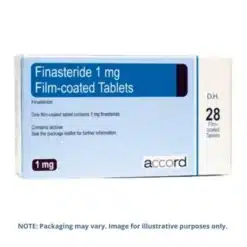
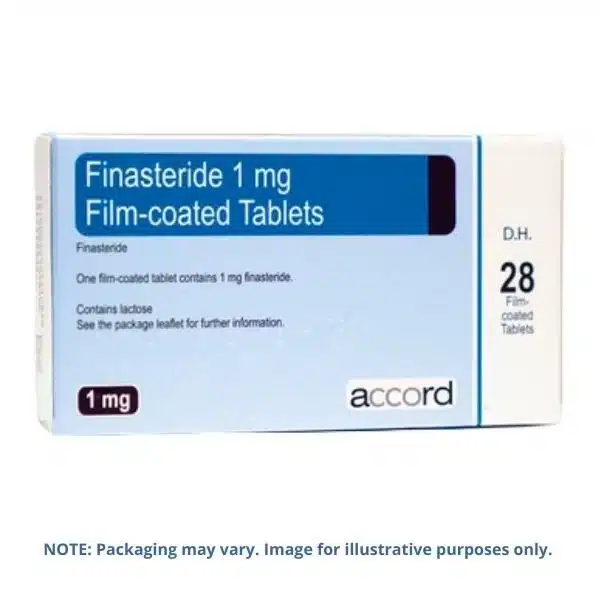
| Medication Name | Finasteride 1mg Tablets |
| Medication Form | Film-coated tablet |
| Used for | Male pattern hair loss (androgenetic alopecia) |
| Who can use | Adult men (aged 18 years and over) |
| Active Ingredient(s) | Finasteride 1mg |
| Usual Dose | One tablet once a day |
| Common Side Effects | Reduced sex drive, difficulty getting an erection, ejaculation problems |
| Prescription Required | Yes |
| Patient Information Leaflet | Finasteride 1mg Patient Information Leaflet |
Finasteride tablets are used to treat male pattern hair loss (androgenetic alopecia) in men. They’re suitable for men with mild to moderate hair loss, but not complete hair loss.
Male pattern hair loss is a common type of hair loss in men, caused by a combination of genetic factors and the hormone DHT (dihydrotestosterone). It can start in your 20s and becomes more common with age, affecting around 80% of white men by the age of 70.
Signs of male pattern hair loss include:
Once hair has been lost over a long period of time, it may not grow back. Finasteride is best started early, before much hair has been lost.
Each hair on your scalp grows from a hair follicle for 2 to 4 years, then rests for 2 to 4 months before falling out. A new hair then grows in its place. Your hairs are all at different stages of this cycle, so it’s normal to lose some hair every day.
In men with male pattern hair loss, DHT shortens the growth phase and makes each new hair thinner. Over time, this leads to visible thinning and balding.
Finasteride belongs to a group of medicines called Type II 5-alpha reductase inhibitors. Finasteride works by preventing this enzyme from turning testosterone into DHT, which lowers DHT levels in the scalp. In one study, Finasteride 1mg lowered scalp DHT levels by around 64% after 6 weeks. This helps reverse the balding process, promote hair growth and prevent further hair loss.
Finasteride is suitable for adult men who want to treat male pattern baldness. It isn’t suitable for women or anyone under 18.
Don’t take Finasteride if you:
Speak to your doctor or pharmacist before taking it if you:
The usual dose of Finasteride is 1mg daily, taken as one tablet for as long as your doctor or pharmacist recommends.
Keep taking it every day, even if you don’t notice a difference straight away. Don’t take more than one tablet a day, as it won’t work faster or better.
Like all medicines, Finasteride can cause side effects, although not everyone gets them. Some side effects ease with continued treatment or go away once treatment stops.
These may affect up to 1 in 100 people:
How often these side effects happen isn’t known:
Stop taking Finasteride and seek medical advice straight away if you get:
If you feel you might harm yourself, call 999 or go to A&E.
Tell your doctor promptly about any changes in your breast tissue, such as lumps, pain, enlargement or nipple discharge. These may be signs of a serious condition, such as breast cancer.
For a full list of side effects, read the patient information leaflet.
If you notice any side effects, including ones not listed here, tell your doctor or pharmacist. You can also report them through the Yellow Card Scheme.
Active ingredient: Finasteride 1mg
Other ingredients: lactose monohydrate, microcrystalline cellulose, sodium starch glycolate, pregelatinised maize starch, docusate sodium, magnesium stearate, hypromellose, hydroxypropyl cellulose, talc, titanium dioxide (E171), red iron oxide (E172) and yellow iron oxide (E172)
The manufacturer of your tablets may vary, so always check the leaflet that comes in your pack.
GOOD Based on 184 reviews
 Posted on Google

 Bradley Robinson30/04/2026
 Absolutely Amazing staff! Such a help thank you so muchPosted on Google
 Samiur Rahman30/04/2026Best pharmacy in the UK. The staff here are very helpful, empathetic, understanding and compassionate. Brilliant customer service and staff are actual people who use their discretion to help people.Posted on Google
 Vivien donnellon29/04/2026Extremely efficient and knowledgeable information given. All my questions were answered and also some advise regarding the issue. Thank you RehanaPosted on Google
 james watkins22/04/2026Brilliant device ordered yesterday received it today
It may take 3 to 6 months for the full effect of Finasteride to develop. In clinical studies, some men noticed an improvement after 3 months, and hair counts were at their highest after around 2 years. Keep taking it every day for as long as your doctor or pharmacist recommends.
If you’re wondering if Finasteride really works to prevent hair loss, a two-year study found that Finasteride improved hair growth in 66% of men, and 83% experienced no further hair loss.
Finasteride can increase hair growth in men with mild to moderate male pattern hair loss, although it won’t regrow all the hair you’ve lost. In 5-year clinical studies, 48% of men taking Finasteride had improved hair growth and a further 42% saw no change. By comparison, 25% of men taking a placebo improved or stayed the same.
Finasteride is suited to men with mild to moderate, but not complete, male pattern hair loss. If you’re weighing up your options, you can see how Finasteride vs Dutasteride compare. Our pharmacists will review your consultation and let you know if Finasteride is suitable for you.
Finasteride is for men only. It’s been shown not to work for hair loss in women, and it could affect an unborn baby’s development.
If you stop taking Finasteride, its benefits start to reverse within 6 months, and you’re likely to lose any hair regrowth within 9 to 12 months. To keep your results, continue taking it for as long as your doctor or pharmacist recommends.
Finasteride doesn’t affect hair on other parts of the body. It works by lowering DHT levels in the scalp.
Finasteride lowers DHT, a hormone your body makes from testosterone. It doesn’t act like testosterone or block its effects, and it isn’t used to lower testosterone levels.
There’s no information about using Finasteride with minoxidil applied to the scalp. Minoxidil tablets are sometimes prescribed alongside Finasteride for hair loss, although this is an unlicensed use. Speak with our pharmacists during your consultation if you’re considering combining treatments.
You can drink alcohol while taking Finasteride, as there are no known interactions between the two. Speak to your pharmacist if you have any concerns.
Infertility has been reported in men who took Finasteride for a long time and had other risk factors that can affect fertility. Semen quality has been reported to improve or return to normal after stopping treatment. Speak to your doctor if you’re trying for a baby.
If it’s less than 6 hours since your dose was due, take it as soon as you remember. If it’s been more than 6 hours, skip the missed dose and take your next tablet at the usual time. Don’t take a double dose to make up for the one you missed.
Contact your doctor straight away. Taking more than one tablet a day won’t make Finasteride work faster or better.
Finasteride isn’t available on an NHS prescription as a treatment for male pattern baldness, so you’ll need a private prescription. After a quick online consultation, you can buy Finasteride 1mg tablets, and they will be delivered in discreet packaging.
Propecia is the brand name, while generic Finasteride is the unbranded version. Both contain 1mg of Finasteride and are taken once a day to treat male pattern hair loss.
Yes, you can take Finasteride 1mg after a hair transplant. In fact, many doctors recommend continuing or starting Finasteride 1 mg post-transplant to help prevent further hair loss and protect the remaining hair follicles.
Finasteride may help the overall effect of the transplant by maintaining hair growth in non-transplanted areas and reducing future hair thinning. Always consult your doctor before starting or resuming any medication after surgery.
No, Finasteride is specifically designed to treat male-pattern hair loss (androgenetic alopecia), which is caused by the hormone DHT. It does not slow down hair loss or improve hair counts caused by alopecia areata, scarring alopecia, or medical conditions or treatments. If you’re experiencing hair loss, it’s important to consult with your pharmacist or GP to work out the cause and explore treatment options.
Finasteride 5mg tablets are used to treat an enlarged prostate (benign prostatic hyperplasia), not hair loss. Only the 1mg strength is used for male pattern hair loss. Don’t take Finasteride 1mg if you already take Finasteride or dutasteride for an enlarged prostate.
“Finasteride is a once-daily tablet for men with mild to moderate male pattern hair loss. It lowers DHT levels in the scalp, which can help slow hair loss and increase hair growth. Results build gradually over a few months, so keep taking it and speak to us if you notice any side effects.”

Dr Hussain Ahmad
Page content authored by Dr Hussain Ahmad, last reviewed by Amjad Khan on 19th October 2026.