Variety of delivery options including next day & free delivery.
Pharmacy, clinic and prescribers based in Greater Manchester.
Start your treatment with a quick and free online consultation.
Variety of delivery options including next day & free delivery.
Pharmacy, clinic and prescribers based in Greater Manchester.
Start your treatment with a quick and free online consultation.
Fill in a quick online consultation for our licensed pharmacists to review.
Our pharmacists will review your treatment to ensure it’s suitable.
Your treatment will be delivered to your door quickly & discreetly.
| Medication Name | Paracetamol Suppositories |
| Medication Form | Rectal suppository |
| Used for | Pain relief and reducing a high temperature (fever) |
| Who can use | Children aged 6 years and over, and adults (strength dependent) |
| Active Ingredient(s) | Paracetamol 250mg or 500mg |
| Usual Dose | Dependent on age and strength; see How To Use section |
| Common Side Effects | Redness or soreness around the back passage |
| Prescription Required | No – Pharmacy (P) medicine |
| Patient Information Leaflet | Paracetamol 250mg Suppositories PIL |
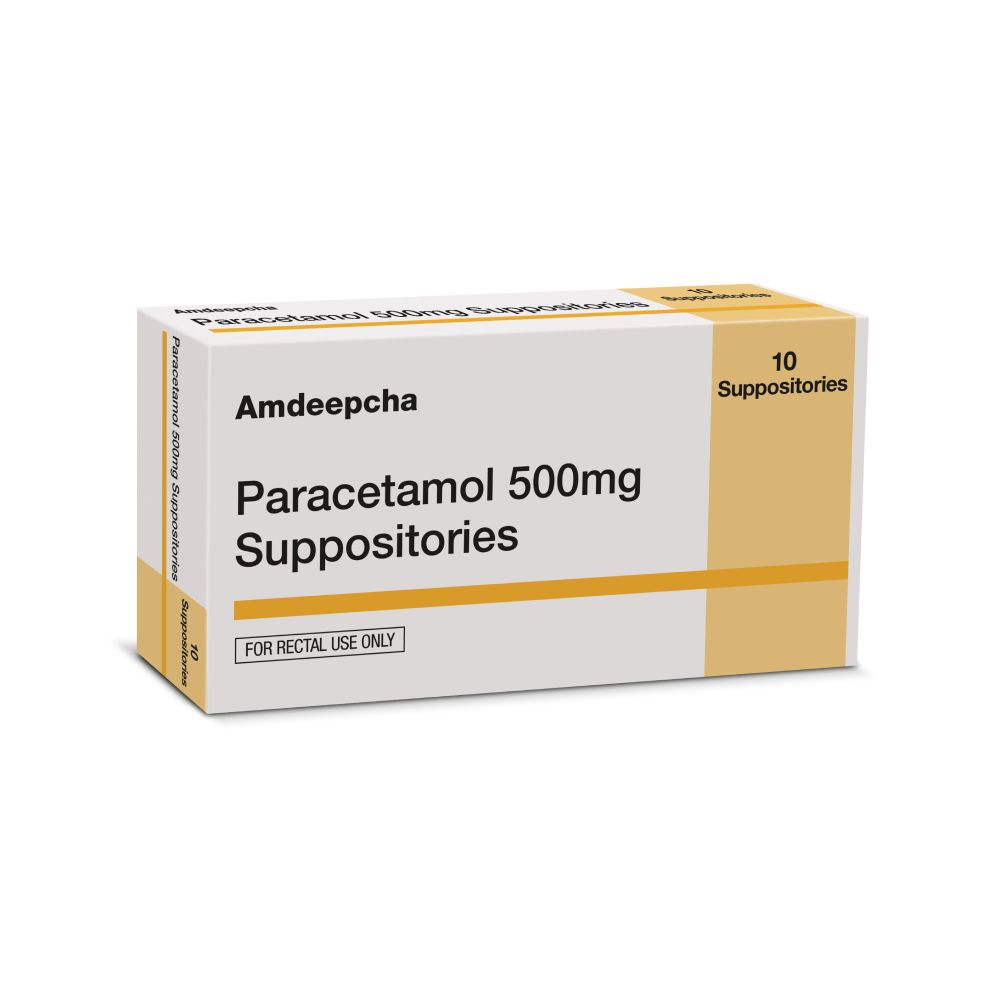
Paracetamol Suppositories are a painkiller (analgesic) inserted into the back passage (rectum) to relieve mild to moderate pain and reduce a high temperature (fever). They belong to a group of medicines called analgesics and come in a small torpedo-shaped form that’s inserted rectally rather than swallowed. They can help with headaches, toothache, earache, sore throats and the aches and pains that come with colds and flu.
Paracetamol Suppositories can be a good option if swallowing tablets or liquid medicine isn’t possible, like when nausea or vomiting is making it hard to keep anything down.
If symptoms don’t improve or get worse after 3 days, ask your doctor or pharmacist for advice.
The 250mg suppositories are for children aged 6 to 12 years. The 500mg suppositories are for children over 10 years old and adults.
Don’t use Paracetamol Suppositories if you or your child:
Speak to a doctor or pharmacist before use if you or your child:
If you’re pregnant, Paracetamol Suppositories can be used at the lowest dose that helps, for the shortest time needed. Contact your doctor if pain or fever doesn’t ease or if you need to use them more often than advised.
Paracetamol Suppositories are for rectal use only. Always take this medicine exactly as described here, or as your doctor or pharmacist has told you.
Empty your bowels before use if you need to. It can help to lie on your front or side on a bed.
To insert the suppository:
If you’re giving the suppository to a child, make sure your child’s bowels are empty beforehand and insert it into your child’s back passage the same way.
Always check the correct dosage before use.
How many suppositories to give your child, or use as an adult, depends on age and weight:
Leave at least 4 hours between doses and don’t use more suppositories than stated above. Always insert whole suppositories; don’t cut or divide them.
If you or your child take more than the recommended dose, contact a doctor straight away, even if you feel well.
Like all medicines, Paracetamol Suppositories can cause side effects, though not everyone gets them.
Stop using Paracetamol Suppositories and seek immediate medical attention if you notice signs of an allergic reaction, such as a rash, swelling of the lips, face, throat or tongue, or difficulty breathing or swallowing.
Using paracetamol every day for several months or more can lead to liver damage. This isn’t a risk when it’s used at the recommended dose for short periods, though it may affect the results of liver function tests.
If you notice any side effects not listed here, tell your doctor or pharmacist. You can also report side effects directly through the Yellow Card Scheme.
Active ingredient: Paracetamol 250mg or 500mg, depending on strength
Other ingredients: Hydrogenated fat, soybean lecithin
GOOD Based on 184 reviews
 Posted on Google
 Bradley Robinson30/04/2026
 Absolutely Amazing staff! Such a help thank you so muchPosted on Google
 Samiur Rahman30/04/2026Best pharmacy in the UK. The staff here are very helpful, empathetic, understanding and compassionate. Brilliant customer service and staff are actual people who use their discretion to help people.Posted on Google
 Vivien donnellon29/04/2026Extremely efficient and knowledgeable information given. All my questions were answered and also some advise regarding the issue. Thank you RehanaPosted on Google
 james watkins22/04/2026Brilliant device ordered yesterday received it today
Paracetamol Suppositories are available without a prescription, as a Pharmacy (P) medicine. You can buy them online after answering a few short questions to help our pharmacist check they’re suitable for you or your child.
Absorption through the back passage tends to be slower and more variable than swallowing paracetamol as a tablet or liquid, so relief may take a little longer to set in. This is why suppositories are generally used when swallowing medicine isn’t possible, rather than for the fastest possible relief.
Paracetamol Suppositories are suitable for children aged 6 and over, with the strength and dose depending on their age and weight. Check the dosing guide before use, and ask a pharmacist if you’re unsure which strength is right for your child.
This isn’t a Paracetamol Suppository for infants. Neither strength is licensed for children under 6 years old and the 500mg strength shouldn’t be used under 10 years old. If your infant or young child needs pain relief or fever relief, speak to a pharmacist or doctor about a suitable alternative.
Paracetamol Suppositories can be used during pregnancy if needed, at the lowest dose that helps and for the shortest time possible. Contact your doctor if pain or fever doesn’t improve or if you need to use them more often than advised. Talk to your doctor before using them if you’re breastfeeding.
Paracetamol Suppositories come in two strengths, 250mg and 500mg. Paracetamol Suppositories 250mg are typically used for children, and Paracetamol Suppositories 500mg for adults, though both offer the same therapeutic effect. You can buy Paracetamol 500mg suppositories for adults, or choose the 250mg strength for a child, and our pharmacist will check you’ve picked the right one.
If you forget to use a suppository, carry on with the next one at the usual time. Don’t use a double dose to make up for a missed one.
Paracetamol overdose carries a risk of delayed, serious liver damage that may not be obvious straight away, even if your child seems well. If you need to go to the hospital, take the packaging or any remaining suppositories with you.
Page content authored by Amjad Khan, last reviewed by Dr Hussain Ahmad on 9th August 2026.