
Royal Mail tracked 24 or 48 hour delivery in plain, unmarked packaging.
Pharmacy, clinic and prescribers based in Greater Manchester.
Where a prescription is needed, the price you see includes your consultation and prescription.
Royal Mail tracked 24 or 48 hour delivery in plain, unmarked packaging.
Pharmacy, clinic and prescribers based in Greater Manchester.
Where a prescription is needed, the price you see includes your consultation and prescription.
Fill in a quick online consultation for our licensed pharmacists to review.
Our pharmacists will review your treatment to ensure it’s suitable.
Your treatment will be delivered to your door quickly & discreetly.
| Medication Name | Sumatriptan Tablets |
| Medication Form | Tablets |
| Used for | Treating migraine attacks |
| Who can use | Adults aged 18 to 65 years |
| Active Ingredient(s) | Sumatriptan (as sumatriptan succinate) |
| Usual Dose | One 50mg tablet as soon as possible after a migraine attack starts |
| Common Side Effects | Feeling sick, tiredness, dizziness, tingling or warmth, chest tightness |
| Prescription Required | Yes |
| Patient Information Leaflet | Sumatriptan Tablets Patient Information Leaflet |
Sumatriptan is a medicine used to treat migraine attacks in adults. A migraine usually causes a moderate or severe throbbing headache on one side of the head, often alongside other symptoms.
Sumatriptan helps relieve the symptoms of migraines, including the headache, feeling or being sick (vomiting) and sensitivity to light and sound. It can be used for both types of migraine, with or without aura. It’s a prescription migraine treatment, so you’ll need a consultation before it can be supplied.
Sumatriptan migraine tablets treat the symptoms once an attack has started. They won’t stop an attack happening, so they shouldn’t be taken to prevent a migraine.
Sumatriptan belongs to a class of drugs known as triptans (5-HT1 receptor agonists). The exact cause of a migraine isn’t fully understood, but symptoms may be caused by the temporary widening of blood vessels in the head.
Triptan migraine medicines, including sumatriptan, work on serotonin receptors on blood vessels in the brain, causing them to narrow. This helps relieve symptoms such as headache and nausea.
Sumatriptan Tablets are for adults aged 18 to 65 who’ve been diagnosed with migraine. They aren’t recommended for children, teenagers or adults over 65.
You shouldn’t take sumatriptan if you:
To order sumatriptan online, you’ll fill in a short consultation so our pharmacists can check it’s right for you.
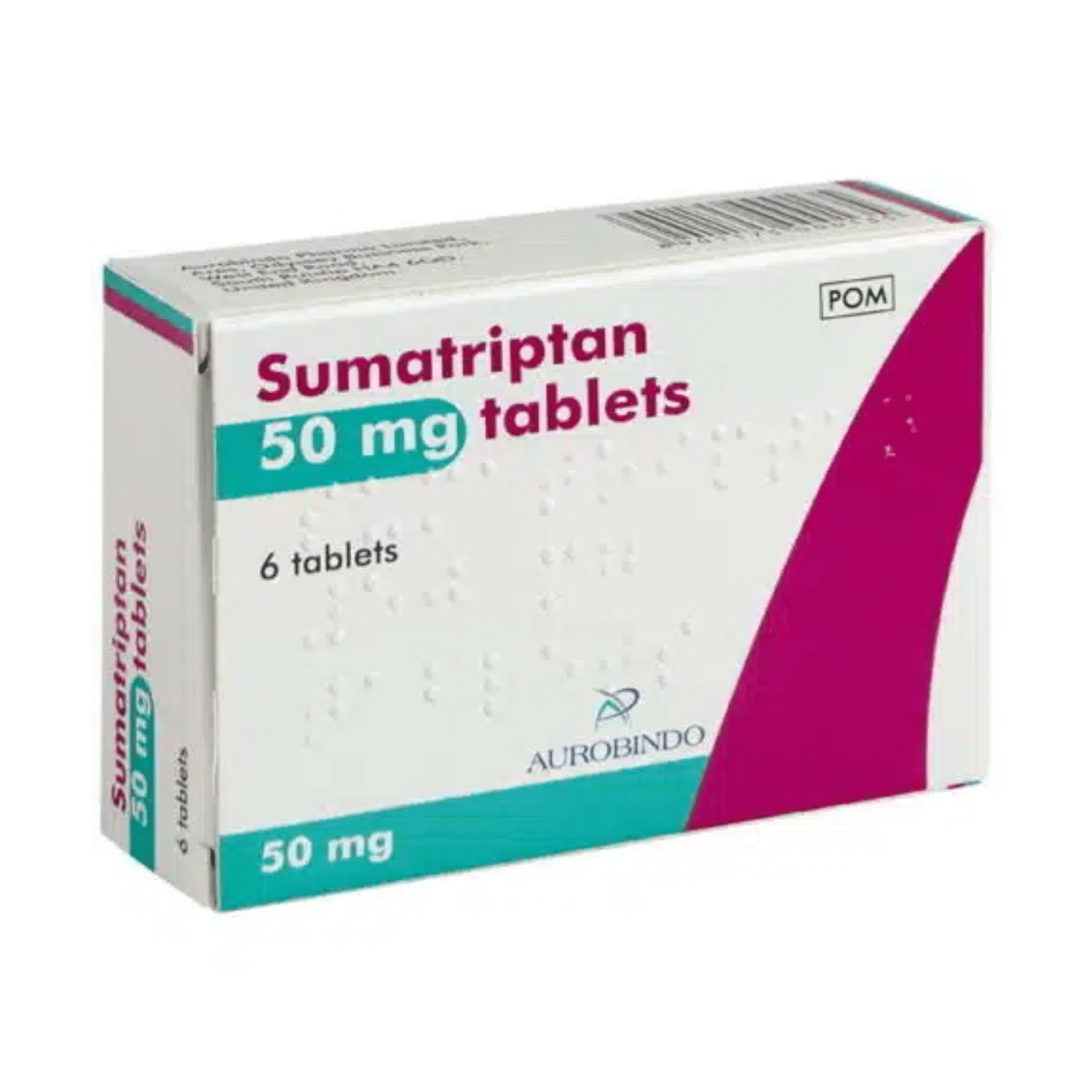
Sumatriptan Tablets come in 50mg and 100mg strengths. In the event of a migraine, the usual dose of sumatriptan is 50mg, although some people need a 100mg tablet. If you have liver problems, your doctor may prescribe 50mg.
If you find the effect too strong or not strong enough, speak to your doctor or pharmacist.
Like all medicines, sumatriptan may cause side effects, although not everybody gets them. Some symptoms may be caused by the migraine itself.
These may affect up to 1 in 10 people:
These may affect up to 1 in 1,000 people:
These may affect up to 1 in 10,000 people:
It’s not known how often these happen:
Stop taking sumatriptan and get medical help straight away if you have:
You can report side effects through the MHRA Yellow Card Scheme.
Active ingredient: Each tablet contains 50mg or 100mg sumatriptan (as sumatriptan succinate)
Other ingredients: Croscarmellose sodium (E468), polysorbate 80 (E433), calcium hydrogen phosphate (E450), microcrystalline cellulose (E460), sodium hydrogen carbonate (E500) and magnesium stearate (E470b)


The maximum sumatriptan dose per day is 300mg. Start with a single dose, and if you don’t get migraine relief, don’t take another for the same attack. If your symptoms ease and then come back, you may take a second tablet as long as you wait at least 2 hours.
Paracetamol can be taken alongside sumatriptan, and the two are often used together to treat a migraine attack. Stick to the usual paracetamol dose and check that other medicines you’re taking don’t also contain paracetamol. Speak to your pharmacist if you’re unsure.
Ibuprofen and sumatriptan can be taken together if ibuprofen is suitable for you. It isn’t right for everyone, including some people with stomach ulcers, asthma or kidney problems. Avoid taking ibuprofen with other anti-inflammatory painkillers, such as naproxen.
Sumatriptan is a prescription medicine because it isn’t suitable for everyone. You shouldn’t take it if you have heart disease, high blood pressure that isn’t mild and treated, circulation problems, serious liver disease or have had a stroke. It also isn’t recommended for under 18s or over 65s. A pharmacist will check your health and other medicines before it’s prescribed.
Sumatriptan tablets usually start to work within 30 to 60 minutes. Take your tablet as soon as possible after your migraine starts.
Sumatriptan can interact with other migraine medicines (ergotamine and other triptans), some antidepressants (SSRIs, SNRIs and MAOIs) and St John’s Wort. Always tell your pharmacist about any other medicines you take.
You can take sumatriptan with or without food, and alcohol doesn’t affect how it works, although it’s best avoided during an attack as it can trigger migraines.
Sumatriptan tablets should be swallowed whole without chewing or crushing. If you feel your dose is too strong, speak to your doctor or pharmacist rather than splitting your tablets. They may be able to prescribe a lower strength.
If you’re pregnant, think you might be or are planning a baby, talk to your doctor before taking sumatriptan, as there’s only limited information about its safety in pregnancy. They’ll discuss if sumatriptan can be used during your pregnancy. If you’re breastfeeding, you’ll need to wait 12 hours after a dose before feeding your baby.
Taking sumatriptan or other migraine medicines on too many days can lead to medication-overuse headaches, where your headaches become more frequent or more severe. Speak to your doctor if you’re taking sumatriptan regularly or your migraines are happening more often.
Sumatriptan and migraines themselves can make you drowsy, dizzy or weak. Don’t drive or use machinery if you’re affected. Wait until you know how sumatriptan affects you before driving.
Sumatriptan is used to treat migraine and isn’t designed for everyday headaches, which are usually treated with painkillers such as paracetamol or ibuprofen. It works on the blood vessel changes linked to migraine attacks rather than acting as a general painkiller. If you’re not sure your headaches are migraines, speak to a pharmacist or doctor.
A temporary rise in blood pressure is a common side effect of sumatriptan. If you have high blood pressure, sumatriptan may not be suitable for you. Tell your pharmacist if you have high blood pressure or take medicine for it.
Sumatriptan won’t work for every migraine attack. If one attack doesn’t respond, you can still take it for your next one. If it seems to be working less well over time, or you’re using it often, speak to your doctor.
Sumatriptan isn’t a beta blocker. It belongs to a group of medicines called triptans, which treat migraine attacks once they’ve started. It isn’t used as a preventative medication, so it won’t stop migraines from happening.
Common side effects include tiredness and drowsiness. Migraines can also leave you feeling tired. If you feel drowsy, avoid driving or using machinery until it passes.
Feeling or being sick is a common side effect of sumatriptan. Nausea is also a common migraine symptom, and sumatriptan can help relieve it as it eases the attack.
Contact your doctor or pharmacist straight away if you take more sumatriptan than you should, as you may get more of the side effects listed above. If you have chest pain or tightness that doesn’t pass quickly or becomes severe, call 999.
You can buy sumatriptan online after completing a short online consultation. Our pharmacists review your answers and, if it’s suitable for you, your tablets are sent out in discreet packaging. Our generic sumatriptan tablets are available in 50mg and 100mg.
Page content authored by Dr Hussain Ahmad (GMC: 7176414), last reviewed by Amjad Khan (GPhC: 2065469) on 19th October 2026.