Variety of delivery options including next day & free delivery.
Pharmacy, clinic and prescribers based in Greater Manchester.
Start your treatment with a quick and free online consultation.
Variety of delivery options including next day & free delivery.
Pharmacy, clinic and prescribers based in Greater Manchester.
Start your treatment with a quick and free online consultation.
Fill in a quick online consultation for our licensed pharmacists to review.
Our pharmacists will review your treatment to ensure it’s suitable.
Your treatment will be delivered to your door quickly & discreetly.
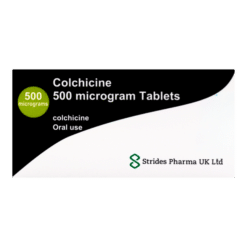
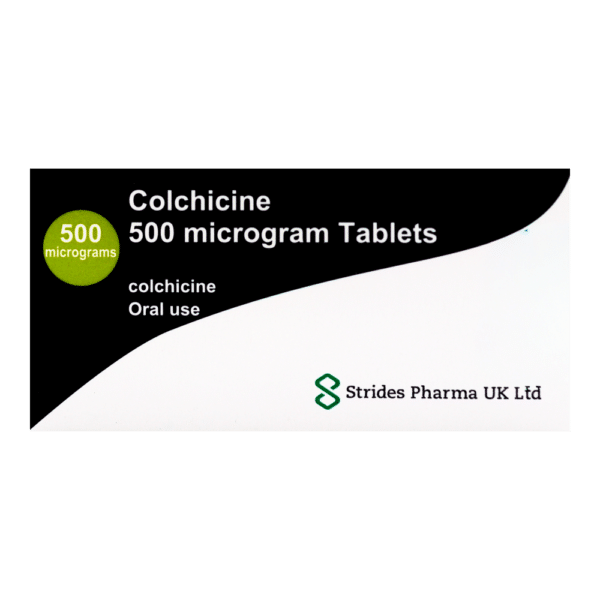
| Medication Name | Colchicine 500 microgram Tablets |
| Medication Form | Tablet |
| Used for | Acute gout attacks and preventing flare-ups when starting urate-lowering treatment |
| Who can use | Adults aged 18 years and over |
| Active Ingredient | Colchicine 500 micrograms |
| Usual Dose | 2 tablets at the first sign of a gout attack, then 1 tablet an hour later |
| Common Side Effects | Nausea, vomiting, stomach pain, diarrhoea |
| Prescription Required | Yes, prescription-only medicine (POM) |
| Patient Information Leaflet | Colchicine Patient Information Leaflet |
Colchicine tablets are used to treat acute gout attacks in adults. Gout is a form of arthritis that happens when uric acid builds up in the blood and forms sharp crystals in a joint, often the big toe, causing sudden pain, swelling and redness.
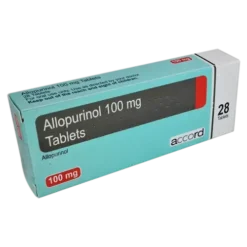
Colchicine is used for short-term treatment of gout, helping settle an attack once it starts. It also helps prevent gout and stop flare-ups when you first start a longer-term treatment like allopurinol, which can trigger attacks in the early weeks.
Colchicine is also used to prevent attacks of Familial Mediterranean Fever, though this is always managed under specialist medical care.
When you have gout, the level of uric acid in your blood rises and can form tiny crystals in the fluid of your joints. Your body treats these crystals as a threat and responds with inflammation, which causes the pain, heat and swelling of an attack.
Colchicine calms this reaction by reducing the activity of the white blood cells that drive the inflammation. As the inflammation settles, the pain and swelling ease.
It’s worth knowing that colchicine doesn’t lower the amount of uric acid in your blood. It treats the attack rather than the underlying cause, which is why it’s used alongside or before a urate-lowering medicine that helps prevent gout over the long term.
Colchicine is suitable for adults aged 18 years and over.
You must not take colchicine if you:
Speak to your doctor or pharmacist before taking colchicine if you:
Your dose depends on why you’re taking colchicine, and your prescriber will confirm the right amount for you.
To treat a gout attack, the usual dose is:
Don’t take more than 12 tablets in a single course. Stop once your symptoms settle or once you’ve reached 12 tablets, whichever comes first, and leave at least 3 days before starting another course.
To prevent flare-ups when you first start a urate-lowering medicine, the usual dose is 1 tablet twice a day.
If you have kidney or liver problems, your dosage will be lower, so follow your prescriber’s instructions closely.
Take colchicine exactly as you’ve been prescribed:
If you find the tablets hard to swallow, speak to your pharmacist rather than crushing them.
Like all medicines, Colchicine Tablets can cause side effects, though not everyone gets them.
These may affect up to 1 in 10 people.
These may affect up to 1 in 100 people.
These may affect up to 1 in 1,000 people.
The frequency of these isn’t known.
Colchicine can occasionally cause serious side effects. Stop taking it and contact a doctor or your nearest A&E straight away if you get nausea, vomiting, stomach pain or diarrhoea, as these can be early signs that the dose is too high for you. Do the same if you notice signs of a serious blood problem, such as a high fever, a sore mouth or throat, or unusual bruising or bleeding.
If you get any side effects not listed here, tell your doctor or pharmacist. You can also report side effects directly through the MHRA Yellow Card scheme.
For a full list of side effects, read the Colchicine Patient Information Leaflet.
Active ingredient: colchicine 500 micrograms per tablet
Other ingredients: microcrystalline cellulose, lactose monohydrate, sodium starch glycolate, magnesium stearate (E572) and povidone K-30
Colchicine tablets contain lactose. If you’ve been told you can’t tolerate some sugars, speak to your doctor before taking them. Each tablet contains less than 1 mmol sodium (23mg), so it’s essentially sodium-free.
GOOD Based on 184 reviews
 Posted on Google
 Bradley Robinson30/04/2026
 Absolutely Amazing staff! Such a help thank you so muchPosted on Google
 Samiur Rahman30/04/2026Best pharmacy in the UK. The staff here are very helpful, empathetic, understanding and compassionate. Brilliant customer service and staff are actual people who use their discretion to help people.Posted on Google
 Vivien donnellon29/04/2026Extremely efficient and knowledgeable information given. All my questions were answered and also some advise regarding the issue. Thank you RehanaPosted on Google
 james watkins22/04/2026Brilliant device ordered yesterday received it today
Colchicine is a prescription-only medicine, so it isn’t sold over the counter. You can order colchicine 500 mcg tablets online from Click2Pharmacy by completing a short consultation, which will be reviewed by one of our pharmacists. If it’s suitable for you, we’ll arrange your prescription and deliver it discreetly to your door.
Colchicine is a potent medication with a narrow safety margin, which means there’s only a small gap between a dose that works and one that becomes toxic. That’s why it’s prescription-only and why sticking to the dose you’re given matters so much. It also isn’t a general painkiller; it works specifically on the inflammation behind a gout attack.
There’s no direct interaction between colchicine and alcohol. That said, alcohol, especially beer and spirits, can trigger gout attacks, so cutting back tends to mean fewer flare-ups. Keeping alcohol to a minimum is sensible while you’re managing gout.
For a gout attack, colchicine is only meant to be used short-term, and a single course shouldn’t go beyond 12 tablets. Your doctor might prescribe colchicine at a lower dose for a longer stretch when you first start a urate-lowering medicine, but that’s done under your prescriber’s guidance with regular monitoring. Long-term use is otherwise reserved for conditions managed by a specialist.
Other options for an acute attack include anti-inflammatory painkillers such as naproxen, or a short course of steroids if anti-inflammatories aren’t suitable. To help prevent gout attacks in future, a urate-lowering medicine like allopurinol is often used. Your pharmacist or doctor can help you find the option that’s right for you.
Colchicine and naproxen work in different ways and are sometimes used together during a severe flare-up, one to calm inflammation and the other to ease pain. They should only be combined on the advice of a prescriber though, so check first rather than doubling up on your own.
For treating gout flares, colchicine works best when you take it at the very first sign of an attack. Many people find that the pain and swelling start to ease within a day or so, though it can take a little longer. If your symptoms haven’t improved by the end of a course, or they’re getting worse, speak to your doctor or pharmacist.
Keep the tablets in the blister inside the outer carton, which protects them from light. Store them out of the sight and reach of children, and don’t use them after the expiry date printed on the packaging.
Take it as soon as you remember. If it’s nearly time for your next dose, skip the one you missed and carry on as normal. Don’t take a double dose to make up for a forgotten one, and never take the tablets closer together than you’ve been told to.
Page content authored by Amjad Khan, last reviewed by Mr Muhammad on 16th September 2026.