Variety of delivery options including next day & free delivery.
Pharmacy, clinic and prescribers based in Greater Manchester.
Start your treatment with a quick and free online consultation.
Variety of delivery options including next day & free delivery.
Pharmacy, clinic and prescribers based in Greater Manchester.
Start your treatment with a quick and free online consultation.
Fill in a quick online consultation for our licensed pharmacists to review.
Our pharmacists will review your treatment to ensure it’s suitable.
Your treatment will be delivered to your door quickly & discreetly.
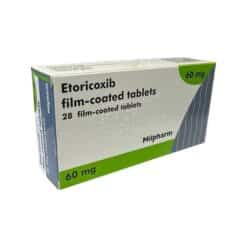
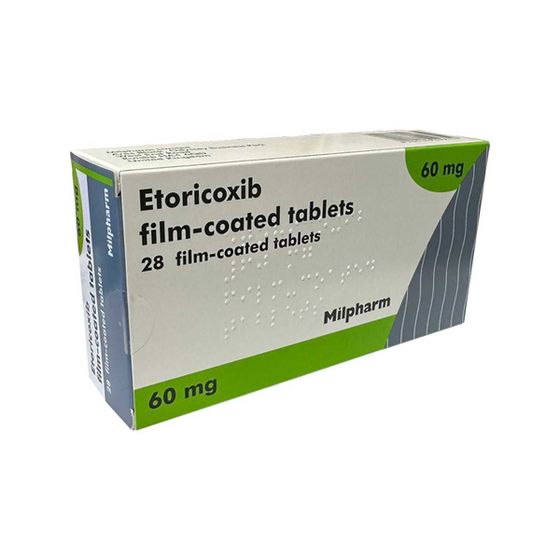
| Medication Name | Etoricoxib 60mg Tablets |
| Medication Form | Film-coated tablet |
| Used For | Pain and inflammation from osteoarthritis, rheumatoid arthritis, ankylosing spondylitis and gout |
| Who Can Use | Adults and young people aged 16 and over |
| Active Ingredient(s) | Etoricoxib 60mg |
| Usual Dose | One tablet once daily (dose depends on the condition being treated) |
| Available Pack Sizes | 28, 56 or 84 tablets |
| Common Side Effects | Stomach pain, headache, dizziness |
| Prescription Required | Yes |
| Patient Information Leaflet | Etoricoxib Patient Information Leaflet |
Etoricoxib tablets are used to reduce joint pain, muscle pain and swelling in people aged 16 and over. They treat several conditions that cause ongoing inflammation:
Etoricoxib is also used for the short-term treatment of moderate pain after dental surgery in people aged 16 and over.
Etoricoxib is a selective COX-2 inhibitor, part of a family of medicines called non-steroidal anti-inflammatory drugs (NSAIDs).
When the body is injured or inflamed, an enzyme called COX-2 helps produce chemicals called prostaglandins. These prostaglandins trigger the pain, swelling and inflammation you feel in an affected joint or muscle.
Etoricoxib blocks the COX-2 enzyme, which reduces the production of those chemicals. This helps ease the pain and bring down the swelling linked to conditions like arthritis and gout.
Because it targets COX-2 rather than the enzymes that help protect the stomach lining, etoricoxib is often considered gentler on the stomach than traditional NSAIDs.
Etoricoxib is suitable for adults and young people aged 16 and over. Your doctor will decide if it’s right for you based on your medical history.
Don’t take Etoricoxib if you:
Speak to your doctor or pharmacist before taking Etoricoxib if you:
Take 1 tablet once daily, with or without food. Swallow the tablet whole with a drink of water. The tablet may start to work faster when taken without food.
Your doctor will prescribe the strength and dose that suits your condition. Take the lowest dose that controls your pain, and don’t take it for longer than necessary:
If you have mild liver disease, don’t take more than 60mg a day. If you have moderate liver disease, don’t take more than 30mg a day. Always follow the instructions given by your doctor or pharmacist.
Like all medicines, Etoricoxib can cause side effects, though not everyone gets them.
These may affect more than 1 in 10 people:
These may affect up to 1 in 10 people:
These may affect up to 1 in 100 people:
These may affect up to 1 in 1,000 people:
Stop taking Etoricoxib and talk to your doctor immediately if you notice:
If you notice any side effects not listed here, tell your doctor or pharmacist. You can also report side effects directly through the Yellow Card Scheme. Reporting side effects helps provide more information on the safety of this medicine.
Active ingredient: etoricoxib 60 mg
Other ingredients: dicalcium phosphate anhydrous, microcrystalline cellulose, croscarmellose sodium and magnesium stearate. The film coating contains hypromellose, titanium dioxide (E171), macrogol, indigo carmine aluminium lake (E132) and iron oxide yellow (E172).
GOOD Based on 184 reviews
 Posted on Google
 Bradley Robinson30/04/2026
 Absolutely Amazing staff! Such a help thank you so muchPosted on Google
 Samiur Rahman30/04/2026Best pharmacy in the UK. The staff here are very helpful, empathetic, understanding and compassionate. Brilliant customer service and staff are actual people who use their discretion to help people.Posted on Google
 Vivien donnellon29/04/2026Extremely efficient and knowledgeable information given. All my questions were answered and also some advise regarding the issue. Thank you RehanaPosted on Google
 james watkins22/04/2026Brilliant device ordered yesterday received it today
Etoricoxib is a prescription-strength anti-inflammatory painkiller from the NSAID family. It’s designed to tackle the pain and swelling caused by conditions like arthritis and gout, rather than everyday aches. Because it’s a selective COX-2 inhibitor, it targets the enzyme responsible for inflammation. Your prescriber will decide the right strength for your condition and always recommend the lowest effective dose.
Avoid taking high-dose aspirin or other anti-inflammatory medicines alongside Etoricoxib, as this raises the risk of stomach problems. Several other medicines can interact with it, including blood thinners such as warfarin, methotrexate, lithium, ciclosporin, and medicines for high blood pressure and heart failure.
There are no specific foods you need to avoid, though taking the tablet without food may help it work faster.
Always tell your doctor or pharmacist about everything you’re taking, including medicines bought without a prescription.
Etoricoxib is taken once a day and can start to work faster when taken on an empty stomach. A lot of people notice relief within a few hours of their first dose, though the full anti-inflammatory benefit can take longer to build, particularly for ongoing conditions like arthritis. If your pain isn’t improving, speak to your doctor or pharmacist rather than increasing the dose yourself.
Etoricoxib is a prescription-only medicine in the UK, so it can’t be bought over the counter. You can order it online from Click2Pharmacy by completing a short consultation. One of our licensed pharmacists will review your answers and, if it’s suitable, issue a prescription and arrange discreet delivery.
All three are NSAIDs, but they work slightly differently. Ibuprofen and naproxen are non-selective NSAIDs, meaning they block both the COX-1 and COX-2 enzymes. Etoricoxib is a selective COX-2 inhibitor, so it mainly targets the enzyme involved in inflammation.
Etoricoxib is prescription-only and generally reserved for conditions like arthritis and gout, while ibuprofen and some naproxen products are available over the counter. You shouldn’t take etoricoxib alongside other anti-inflammatory medicines, so speak to your pharmacist if you’re already using one.
As a general precaution with anti-inflammatory medicines, it’s sensible to keep alcohol to a minimum, since it can irritate the stomach lining and add to the risk of stomach upset or bleeding. If you’re unsure how much is safe for you, check with your doctor or pharmacist.
Etoricoxib and paracetamol can usually be taken together and are often combined to manage pain in different ways. Take care not to exceed the recommended dose of either medicine, and avoid other products that also contain paracetamol. If you’re taking several pain medicines, ask your pharmacist to check that the combination is right for you.
Some medicines used for mental health conditions need extra care alongside etoricoxib. Lithium, which is used to treat some types of depression, is one your doctor may want to monitor if you’re taking it with etoricoxib. Antidepressants vary a lot, so the safest approach is to tell your doctor or pharmacist exactly what you’re taking before you start. They’ll advise if any monitoring or adjustment is needed.
Wheezing and shortness of breath are recognised side effects of etoricoxib, and anti-inflammatory painkillers like etoricoxib can sometimes affect people with asthma. If your asthma symptoms get worse, use your reliever inhaler as normal and speak to your doctor or pharmacist promptly. If you develop sudden or severe breathing difficulties or swelling of the face, lips, tongue or throat, stop taking the tablets and seek immediate medical help.
If you miss a dose, just carry on with your usual schedule the following day. Don’t take a double dose to make up for the one you forgot. If you’re ever unsure, speak to your doctor or pharmacist.
Page content authored by Amjad Khan, last reviewed by Mr Muhammad on 17th July 2026.