If you’ve had unprotected sex or your contraception has failed, you’ll want to know how well the emergency contraceptive pill actually works.
Effectiveness depends on which type you take, how quickly you act, and a few personal factors.
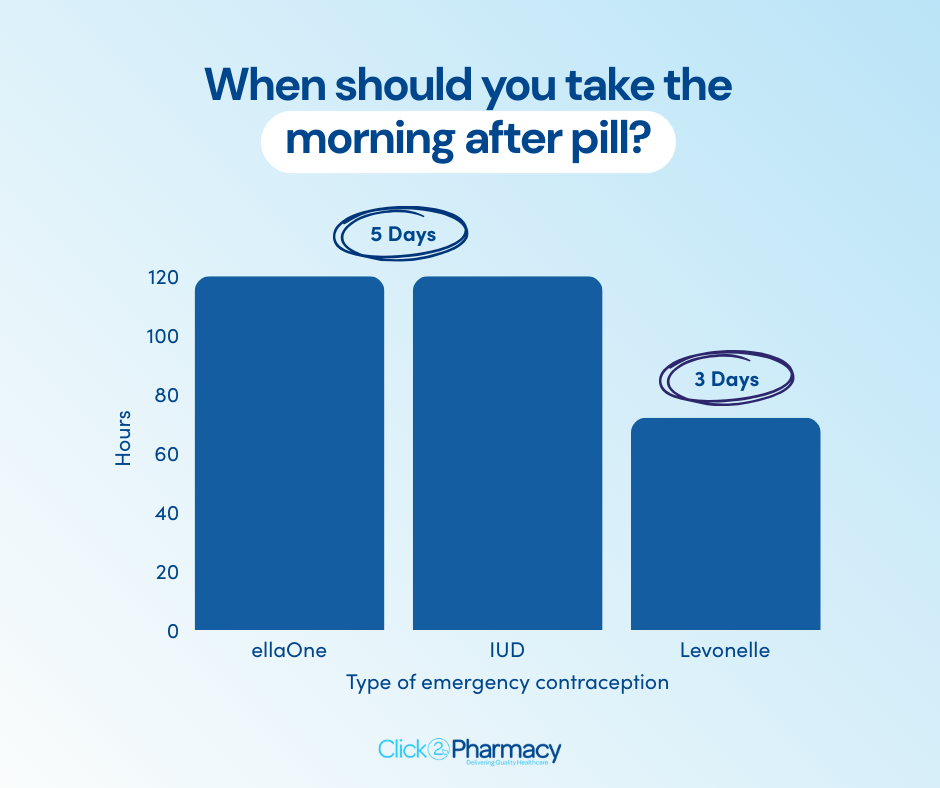
There are three types of emergency contraception available in the UK.
| Type | Effectiveness | Time Window | Pregnancies Prevented |
| ellaOne (ulipristal acetate) | Up to 99% | Within 120 hours (5 days) | 95%+ of expected pregnancies |
| Levonorgestrel (e.g. Levonelle) | Up to 95% | Within 72 hours (3 days) | 85% of expected pregnancies |
| Copper IUD (emergency IUD) | 99.9%+ | Within 120 hours (5 days) | 99%+ of expected pregnancies |
When contraception is listed as “up to 99% effective”, it describes relative risk reduction, meaning how much emergency contraception lowers your pregnancy risk compared to not taking anything.
For example, if 100 women have unprotected sex at a fertile time, roughly 8 would get pregnant without any contraception. When you use emergency contraception, that drops to 1 to 3 with levonorgestrel, around 1 with ellaOne, and fewer than 1 in 1,000 with the copper IUD.
Both pills should be taken as soon as possible. It’s more effective the sooner you take it after unprotected sex, so don’t wait to see if your period arrives on time.
Levonelle must be used within 3 days after unprotected sex, but effectiveness declines quickly:
After 72 hours, Levonellel is not recommended.
ellaOne is the most effective hormonal option, and can be used within 5 days (120 hours) of unprotected sex. It’s more effective if you take it earlier, but unlike levonorgestrel, it maintains consistent effectiveness throughout the full window with no sharp decline.
Pregnancy rates are 0.9-1.8% when used within 120 hours, with no significant difference between 72 and 120 hours.
ellaOne prevents roughly twice as many pregnancies as levonorgestrel overall, and up to 2.5 times as many in the first 24 hours.
Both pills work by delaying ovulation. Once ovulation has already happened, neither can reliably prevent pregnancy.
Where possible, take ellaOne as it is the better option in most situations. It is particularly important if:
If levonorgestrel is your only option, take it. It’s still significantly better than not taking anything.
Weight has a significant effect on levonorgestrel specifically. Pregnancy risk increases sharply from around 70 to 75 kg, and at approximately 80kg, pregnancy risk reaches 6% or higher, comparable to taking no contraception at all.
ellaOne is less affected by BMI, though some reduction in effectiveness does happen at higher weights. At higher body weights, drug levels may fall below those needed to delay ovulation, particularly with levonorgestrel.
| BMI Range | Levonorgestrel | ellaOne | Recommendation |
| Under 25 | Standard effectiveness | Standard effectiveness | Either pill suitable |
| 25 to 30 | Reduced; risk rises from around 70 to 75 kg | Slightly reduced; still better than levonorgestrel | ellaOne preferred |
| Over 30 | Significantly reduced – the risk of pregnancy is similar to what might be expected without any contraception | Some reduction – still more effective than levonorgestrel | Copper IUD first-line; ellaOne second-line |
Emergency pills work by delaying the release of an egg and cannot reverse ovulation once it has happened. Conception probability peaks around day 13, with fertile window chances rising from around 2% early in the cycle to 58% mid-cycle before falling again.
Certain medicines speed up the liver metabolism of levonorgestrel, reducing its effectiveness.
Levonorgestrel is metabolised by the CYP3A4 enzyme, and drugs that induce this enzyme lower circulating levonorgestrel levels in your bloodstream. This includes some forms of hormonal contraception, like the combined pill, which may interact with ulipristal acetate and reduce its effectiveness.
These include:
If you’ve taken any of these in the past four weeks:
Emergency contraception is highly effective, but not 100%. If you do become pregnant after taking the morning after pill, failure rates are low: around 1-3 in 100 for levonorgestrel and 1-2 in 100 for ulipristal acetate.
Failure is more likely if:
Take a pregnancy test if your period is 7 or more days late, or if you experience pregnancy symptoms like breast tenderness, nausea, or fatigue three weeks after taking emergency contraception. A period that is significantly lighter or heavier than usual is also worth investigating.
Side effects from emergency contraception, including nausea, headache, and irregular bleeding, are common, usually mild, and short-lived. If you vomit within 2 hours of taking the pill, it may not have been absorbed properly, and you should seek advice about taking another dose.
Only a small number of women experience symptoms that closely mimic early pregnancy. If symptoms persist beyond a few days of taking, take a pregnancy test.
The morning after pill shouldn’t be used as a regular method of contraception. Each use covers that episode of unprotected sex, but it is not designed to replace ongoing methods.
Repeated use increases the cumulative risk of taking it too late in the cycle. One study found failures occurred in about 1% of levonorgestrel users in the first month, with none of the copper IUD users becoming pregnant.
If you’re relying on regular contraception that has failed, or find yourself needing emergency contraception repeatedly, it’s worth speaking with a doctor or pharmacist about a more reliable ongoing method.
If you need emergency contraception, our online clinic makes it easy to access the right option quickly and discreetly, from the comfort of your own home.
Simply complete our short health questionnaire and one of our pharmacists will review your answers to confirm which option is suitable for you. If approved, your medication will be dispatched promptly in discreet packaging.
Need emergency contraception now? Start your consultation today. The sooner you act, the more effective it will be.