Variety of delivery options including next day & free delivery.
Pharmacy, clinic and prescribers based in Greater Manchester.
Start your treatment with a quick and free online consultation.
Variety of delivery options including next day & free delivery.
Pharmacy, clinic and prescribers based in Greater Manchester.
Start your treatment with a quick and free online consultation.
Fill in a quick online consultation for our licensed pharmacists to review.
Our pharmacists will review your treatment to ensure it’s suitable.
Your treatment will be delivered to your door quickly & discreetly.
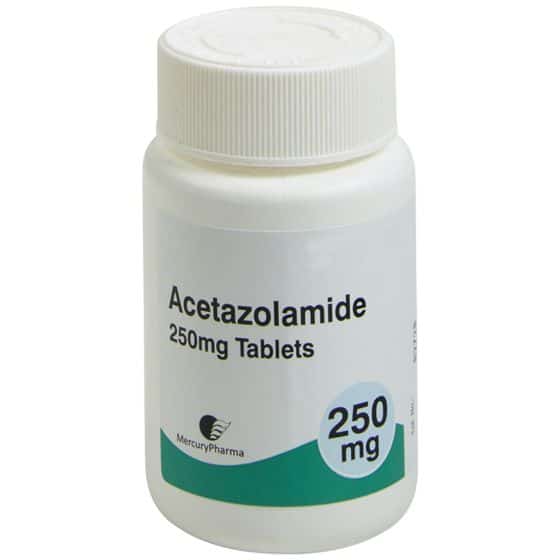
| Medication Name | Acetazolamide Tablets 250mg |
| Medication Form | Oral tablet |
| Used For | Altitude sickness prevention, glaucoma, fluid retention, and epilepsy |
| Who Can Use | Adults (when prescribed by a healthcare professional) |
| Active Ingredient(s) | Acetazolamide 250mg |
| Usual Dose | 125mg twice a day
dose varies depending on the condition being treated |
| Common Side Effects | Tingling in fingers and toes, increased urination, nausea, headache, dizziness |
| Prescription Required | Yes |
| Patient Information Leaflet | Acetazolamide Tablets 250mg PIL |
Acetazolamide tablets are most commonly prescribed to prevent altitude sickness. When you ascend quickly to high altitudes, lower oxygen levels can trigger symptoms of acute mountain sickness such as headaches, nausea, dizziness and fatigue. Acetazolamide helps your body adapt by speeding up the acclimatisation process.
Beyond altitude sickness prevention, acetazolamide tablets are also used to treat:
Your doctor will prescribe the most appropriate dose based on the condition being treated.
Acetazolamide (also known as Diamox) belongs to a group of medicines called carbonic anhydrase inhibitors. It works by blocking an enzyme that controls fluid production in the body.
For altitude sickness, acetazolamide can help stimulate deeper, faster breathing, raising the amount of oxygen in the blood and speeding up acclimatisation.
For other conditions, the same mechanism helps lower pressure inside the eye, remove excess fluid from the body and stabilise abnormal nerve activity.
Acetazolamide tablets are suitable for adults when prescribed by a doctor or pharmacist.
Don’t take acetazolamide if you:
Talk to your doctor before taking acetazolamide if you:
Acetazolamide may interfere with heart medicines, blood pressure medicines, blood thinners, diabetes medicines, epilepsy medicines, steroids, aspirin, lithium, ciclosporin and other carbonic anhydrase inhibitors.
Acetazolamide shouldn’t be taken during pregnancy or if you are planning to become pregnant. It can be taken while breastfeeding, but only on a doctor’s advice.
The recommended dose of acetazolamide is 125mg twice daily, commenced 1 day prior to ascent to high altitude and continued for at least 2 days after reaching the highest altitude.
A trial dose for 1 or 2 days should be taken prior to travel to check for side effects.
Swallow the tablets whole with a glass of water, just before or just after a meal. Don’t chew or crush them.
If you miss a dose, take it as soon as you remember. If it’s within two hours of your next scheduled dose, skip the missed tablet and continue as normal. Don’t take a double dose to make up for a missed one.
If you take too many tablets, seek medical help immediately by calling your doctor or going to your nearest A&E. Take any remaining tablets and the packaging with you.
Like all medicines, acetazolamide can cause possible side effects, although not everyone will experience them.
Commonly reported side effects include:
Contact your doctor if you experience:
Seek medical attention immediately if you notice:
With long-term use, acetazolamide can occasionally affect potassium or sodium levels in the blood and may increase the risk of kidney stones or bone thinning. Your doctor may arrange blood tests to monitor this.
For a full list of side effects, read the Patient Information Leaflet.
Active ingredient: acetazolamide 250mg
Other ingredients: dicalcium phosphate, corn starch, magnesium stearate, sodium starch glycolate and povidone.
This medicine contains less than 1 mmol sodium (23mg) per dose and is considered essentially sodium-free.
GOOD
Standard guidance is to begin taking acetazolamide 250mg tablets 1 to 2 days before starting your ascent and to continue for 2 days after reaching your highest altitude. Your prescriber will confirm the exact timing based on your trip.
You should continue taking acetazolamide for 2 days after reaching your highest altitude. Stopping too early may reduce its effectiveness as your body continues to acclimatise at altitude. If you develop symptoms of altitude sickness at any point, descend and seek medical advice regardless of your medication.
Acetazolamide supports your body’s acclimatisation process but isn’t a substitute for sensible ascent planning. Ascending gradually and building in rest days remain the most important steps in preventing altitude sickness.
Acetazolamide increases urination, so staying well hydrated is important throughout your trip. Drink plenty of water regularly and avoid alcohol, which can worsen dehydration at altitude.
Page content authored by Amjad Khan, last reviewed by Mr Muhammad on 17th July 2026.