Variety of delivery options including next day & free delivery.
Pharmacy, clinic and prescribers based in Greater Manchester.
Start your treatment with a quick and free online consultation.
Variety of delivery options including next day & free delivery.
Pharmacy, clinic and prescribers based in Greater Manchester.
Start your treatment with a quick and free online consultation.
Fill in a quick online consultation for our licensed pharmacists to review.
Our pharmacists will review your treatment to ensure it’s suitable.
Your treatment will be delivered to your door quickly & discreetly.
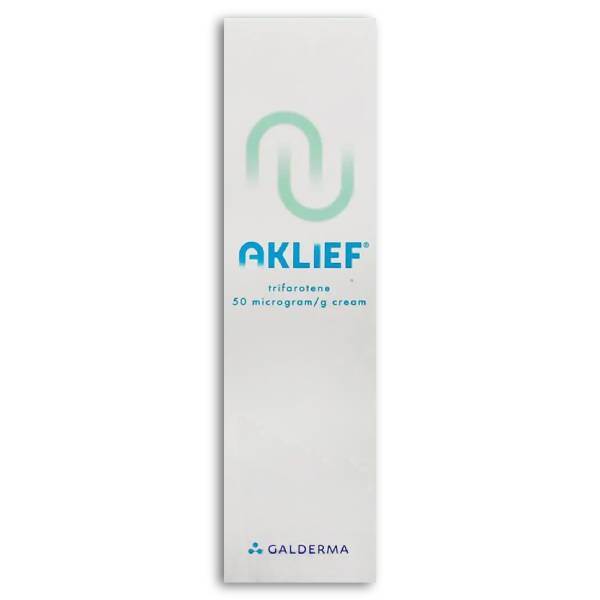
| Medication Name | Aklief Cream |
| Active Ingredient | Trifarotene 0.005% (50 micrograms/g) |
| Medication Form | Topical cream |
| Used to Treat | Acne vulgaris |
| Available Strengths | 0.005% |
| Other names this medication is known by | Trifarotene cream, Selgamis |
| Common Side Effects | Application site irritation, redness, peeling, dryness, stinging/burning |
| Do you need a prescription for it? | Yes |
| How should it be applied? | Once daily in the evening to clean, dry skin |
| Patient Information Leaflet | Aklief Cream Patient Information Leaflet |
Aklief contains trifarotene, a topical retinoid that works by affecting how your skin cells develop and shed. Retinoids, derived from vitamin A, are well-known for their effectiveness as an acne treatment.
When you apply Aklief to your skin, trifarotene helps prevent your pores from becoming blocked. It does this by encouraging your skin cells to turn over more quickly and preventing dead skin cells from building up inside your pores. This process helps stop whiteheads and blackheads from forming in the first place.
Trifarotene also has anti-inflammatory properties, which means it helps reduce the redness and swelling that come with inflammatory acne spots. By tackling both the blockages and the inflammation, Aklief addresses multiple causes of acne at once.
The cream works gradually over time, so you’ll need to use it consistently for several weeks before seeing the full benefits. Most people start to see improvement within the first few months of treatment.
Aklief cream is specifically used for the treatment of acne vulgaris on the face and trunk (chest, shoulders, and back) in people 12 years of age and older. It’s particularly effective when you have moderate acne or severe acne with numerous acne lesions, including:
Aklief is designed for cases where you have many comedones and inflammatory spots that need treatment. It works on both non-inflammatory acne (whiteheads and blackheads) and inflammatory acne (red, swollen spots).
The medication is suitable for treating acne on multiple areas of your body at once, so if you have acne on both your face and your back or chest, you can use Aklief cream on all affected areas.
Aklief is suitable for people aged 12 years and older who have acne vulgaris on their face and/or trunk. It can be used by teenagers and adults who need treatment to manage their acne symptoms.
However, Aklief may not be suitable for everyone. You should not use Aklief if you:
Before starting treatment with Aklief, always inform your doctor or pharmacist if you:
If you’re breastfeeding, you and your doctor will need to decide whether to stop breastfeeding or avoid using Aklief, considering the benefits of both. If you do use Aklief while breastfeeding, don’t apply it to your chest or breast area to avoid the baby coming into contact with the cream.
Aklief should be applied once daily in the evening to clean, dry skin:
If cream accidentally gets in your eyes or mouth, rinse the area immediately and thoroughly with lukewarm water.
Continue using Aklief as prescribed by your doctor. Your doctor will assess your progress after three months of treatment to see if you need to continue.
Like all medications, Aklief can cause side effects, although not everyone experiences them. The most common side effects affect the areas where you’ve applied the cream.
The following side effects may affect up to 1 in 10 people:
These side effects are often experienced when you first start using Aklief and typically improve as your skin adjusts to the treatment. Using a moisturiser from the start of treatment can help prevent or reduce dryness and irritation.
The following side effects may affect up to 1 in 100 people:
The following side effects may affect up to 1 in 1,000 people:
If you experience redness, peeling, dryness, or stinging/burning, contact your doctor. They may recommend using a moisturiser (if you haven’t already started one), applying the cream less often, or taking a short break from treatment. If symptoms persist despite these measures, you may need to stop using the cream.
If you experience a severe allergic reaction or any side effects become severe or persistent, stop using Aklief and contact your doctor or pharmacist immediately.
You can report side effects to the MHRA (Medicines and Healthcare products Regulatory Agency) to help monitor the medication’s safety.
Active ingredient: Trifarotene 50 micrograms per gram (0.005%)
Inactive ingredients: Allantoin, Simulgel 600 PHA (copolymer of acrylamide and sodium acryloyldimethyltaurate, isohexadecane, polysorbate 80, sorbitan oleate), cyclomethicone, ethanol, phenoxyethanol, propylene glycol (E1520), medium-chain triglycerides, and purified water.
GOOD Based on 184 reviews
 Posted on Google
 Bradley Robinson30/04/2026
 Absolutely Amazing staff! Such a help thank you so muchPosted on Google
 Samiur Rahman30/04/2026Best pharmacy in the UK. The staff here are very helpful, empathetic, understanding and compassionate. Brilliant customer service and staff are actual people who use their discretion to help people.Posted on Google
 Vivien donnellon29/04/2026Extremely efficient and knowledgeable information given. All my questions were answered and also some advise regarding the issue. Thank you RehanaPosted on Google
 james watkins22/04/2026Brilliant device ordered yesterday received it today
Aklief contains trifarotene, which is a fourth-generation retinoid. It’s designed to be effective while targeting specific receptors in the skin, which may help reduce some of the irritation associated with older retinoids. Like all retinoids, it can cause skin irritation, especially when you first start using it, but using a moisturiser from the beginning can help manage this.
No, Aklief and Tretinoin are different medications, though both are retinoids used to treat acne. Aklief contains trifarotene, while Tretinoin is a different retinoid compound. They work in similar ways by affecting skin cell turnover, but trifarotene is a newer, fourth-generation retinoid that targets specific receptors in the skin.
Aklief is primarily designed to treat active acne by preventing pores from becoming blocked and reducing inflammation. While retinoids can help improve skin texture and may have some effect on the appearance of acne scarring over time by promoting skin cell turnover, Aklief is not specifically licensed or marketed as a treatment for acne scars.
When you start to use Aklief, you might experience ‘purging’, where your skin appears to get worse before it gets better. This happens because the retinoid speeds up skin cell turnover, bringing underlying blocked pores to the surface more quickly. This is a normal part of the treatment process and typically improves as you continue using the medication.
Aklief is licensed specifically for treating acne vulgaris, not for anti-ageing or wrinkle reduction. While some retinoids are used for anti-ageing purposes, Aklief has been studied and approved only for acne treatment.
Yes, skin irritation and redness are common side effects of Aklief, especially when you first start using it. Many people experience redness, peeling, dryness, and stinging or burning at the application site. These side effects typically improve as your skin adjusts to the treatment.
While retinoids can help with skin cell turnover, which may have some effect on post-inflammatory hyperpigmentation (dark spots left after acne), Aklief is not specifically licensed for treating dark spots or pigmentation issues.
Aklief works gradually over time. Most people start to see improvements within the first few months of treatment, but you need to use it consistently for several weeks before seeing noticeable results.
No, Aklief is a prescription-only medication in the UK. You can purchase Aklief online from Click2Pharmacy after completing an online consultation, which our licensed pharmacists will review before issuing your prescription.
Page content authored by Amjad Khan, last reviewed by Mr Muhammad on 8th August 2026.