Variety of delivery options including next day & free delivery.
Pharmacy, clinic and prescribers based in Greater Manchester.
Start your treatment with a quick and free online consultation.
Variety of delivery options including next day & free delivery.
Pharmacy, clinic and prescribers based in Greater Manchester.
Start your treatment with a quick and free online consultation.
Fill in a quick online consultation for our licensed pharmacists to review.
Our pharmacists will review your treatment to ensure it’s suitable.
Your treatment will be delivered to your door quickly & discreetly.
| Medication Name | Azithromycin Tablets & Suspension |
| Medication Form | Film-coated tablets or oral suspension |
| Used for | Bacterial infections including chlamydia, chest infections, ear, nose & throat infections and skin infections |
| Who can use | Adults and adolescents weighing 45kg or more (tablets); children and adults (suspension, dose based on weight) |
| Active Ingredient(s) | Azithromycin (as azithromycin dihydrate) |
| Usual Dose | 1000mg as a single dose for chlamydia; 500mg once daily for 3 to 5 days for other infections |
| Common Side Effects | Diarrhoea, stomach discomfort, nausea, headache |
| Prescription Required | Yes, this is a Prescription Only Medicine (POM) |
| Patient Information Leaflet | Azithromycin Tablets Patient Information Leaflet |
Azithromycin can be used to treat:
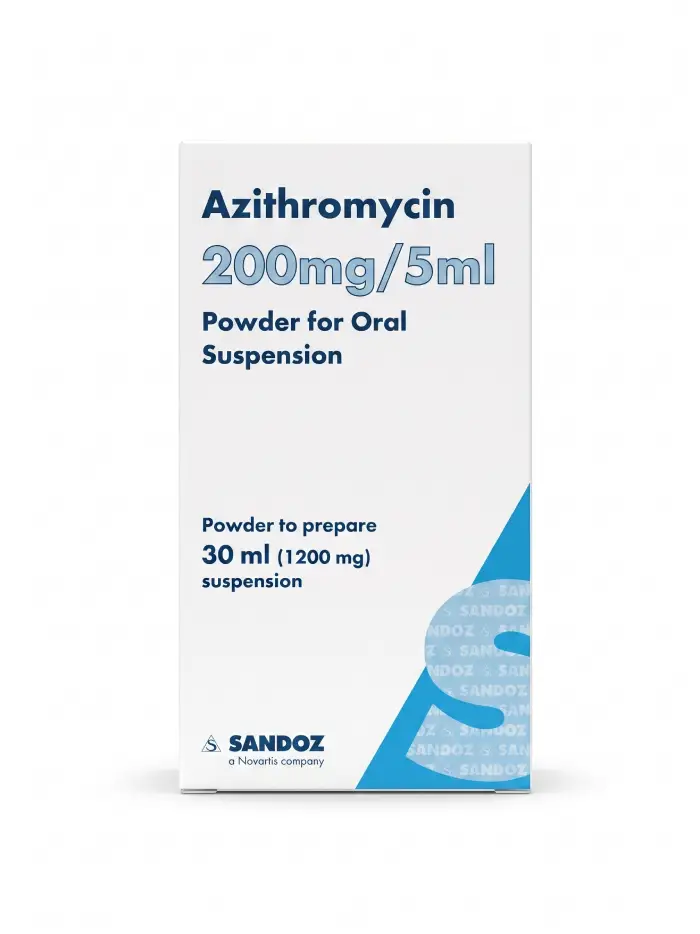
The azithromycin oral suspension is used for patients who need a liquid form, including children being treated for ear infections, pneumonia and throat infections.
Azithromycin won’t work against viral infections such as colds or flu.
Azithromycin belongs to a group called macrolide antibiotics. It works by blocking bacterial growth, preventing them from making the proteins they need to survive and multiply. Without these proteins, the bacteria can’t survive and your immune system is able to clear the infection.
One practical benefit of azithromycin is how it behaves in the body. It builds up in infected tissue and is slowly released over time, so it keeps working for several days after your last dose. This is why a short course, or even a single dose in the case of azithromycin chlamydia treatment, is enough to treat the infection effectively.
Azithromycin tablet uses and suspension uses cover the same bacterial infections; the difference is simply the form. Azithromycin tablets are suitable for adults and adolescents weighing 45kg or more. The oral suspension is suitable for children (dose based on body weight) and for adults who can’t swallow tablets.
Don’t take azithromycin if you:
Speak to your doctor or pharmacist before taking this medication if you:
Azithromycin can interact with a number of medicines. Tell your doctor or pharmacist if you are taking any of the following:
This isn’t a complete list. Always tell your doctor or pharmacist about all medicines, supplements and herbal remedies you’re taking before starting azithromycin. For NHS medicines information on azithromycin, you can also visit NHS.uk.
Pregnant women should only take azithromycin if a doctor decides the benefits outweigh the risks. Azithromycin passes into breast milk, so your doctor will advise if you need to stop breastfeeding during treatment.
Always take azithromycin exactly as your doctor or pharmacist has told you. The dose of azithromycin tablets or suspension will depend on the type of infection being treated.
Complete the full course of azithromycin, even if you start to feel better before it’s finished. Stopping early can allow the infection to return.
Azithromycin 500mg tablets can be taken with or without food. Taking them just before a meal may help if they upset your stomach. Tablets should be swallowed whole with a glass of water.
The usual doses for adults and adolescents weighing 45kg or more are:
The azithromycin suspension should be shaken well before each dose. Use the dosing device provided to measure the correct amount, as using something like a household teaspoon won’t be accurate enough. It can be taken with or without food.
Your doctor or pharmacist will tell you exactly how much azithromycin to give and how often.
Like all medicines, azithromycin can cause side effects, though not everyone gets them.
Stop taking azithromycin and get medical help straight away if you notice any of the following:
You can report any side effects to the MHRA through the Yellow Card Scheme.
Azithromycin can affect your ability to drive or use machinery, as it may cause dizziness, drowsiness or visual disturbances in some people. Take care until you know how it affects you.
Active ingredient: Azithromycin dihydrate (250mg or 500mg per tablet)
Other ingredients: Calcium hydrogen phosphate, pregelatinised maize starch, croscarmellose sodium, sodium lauryl sulfate, magnesium stearate, lactose monohydrate, hypromellose, titanium dioxide (E171), triacetin
Active ingredient: Azithromycin dihydrate (200mg per 5ml when reconstituted)
Other ingredients: Aspartame, colloidal anhydrous silica, banana flavour, cherry flavour, hydroxypropylcellulose, sucrose, trisodium phosphate anhydrous, vanilla flavour, xanthan gum
GOOD
Azithromycin is a broad-spectrum antibiotic, which means it works against a wide range of bacteria. It’s considered effective rather than unusually strong and remains active in the body long after the last dose, which allows short treatment courses to be effective. It’s one of the most widely prescribed antibiotics in the UK for conditions such as chlamydia and chest infections.
Azithromycin isn’t licensed for acne treatment in the UK. While some antibiotics are used to treat acne, azithromycin isn’t a standard option. If you’re looking for antibiotic treatment for acne, speak to your doctor or pharmacist about suitable options.
There’s no direct interaction between azithromycin and alcohol, but it’s sensible to avoid or limit alcohol during any course of antibiotics. Alcohol can worsen some of the side effects of azithromycin, such as nausea and stomach discomfort and may affect how well your body recovers from the infection.
You should avoid sex, including oral sex, until you and any sexual partners have completed treatment and have been given the all-clear. For chlamydia treated with a single dose of azithromycin, this means waiting at least 7 days after taking the dose. Having sex too soon risks reinfection or passing the infection on to others.
Pregnant women should only take azithromycin if a doctor decides the benefits outweigh the risks. Azithromycin passes into breast milk, so your doctor will advise if you need to stop breastfeeding during treatment.
You can take tablets with or without food, so there are no specific foods you need to avoid. If you find the tablets upset your stomach, taking them just before a meal may help. There are no known interactions with specific foods or drinks, though it’s sensible to stay well hydrated during any antibiotic course.
Azithromycin has a longer half-life compared to most antibiotics. It builds up in body tissues and continues to work for up to 10 days after the last dose is taken. This is why a short course is effective, as the medicine keeps acting against bacteria well after you’ve finished taking it.
Azithromycin isn’t typically used to treat urinary tract infections (UTIs) in the UK. UTIs are usually caused by bacteria such as E. coli, which aren’t reliably covered by azithromycin. Other antibiotics are more appropriate for UTI treatment.
If you forget a dose, take it as soon as you remember, as long as it’s at least 12 hours before the next dose is due. If it’s less than 12 hours, skip the missed dose and continue as normal. Don’t take a double dose to make up for a forgotten one.
Page content authored by Amjad Khan, last reviewed by Mr Muhammad on 2nd June 2026.