Variety of delivery options including next day & free delivery.
Pharmacy, clinic and prescribers based in Greater Manchester.
Start your treatment with a quick and free online consultation.
Variety of delivery options including next day & free delivery.
Pharmacy, clinic and prescribers based in Greater Manchester.
Start your treatment with a quick and free online consultation.
Fill in a quick online consultation for our licensed pharmacists to review.
Our pharmacists will review your treatment to ensure it’s suitable.
Your treatment will be delivered to your door quickly & discreetly.
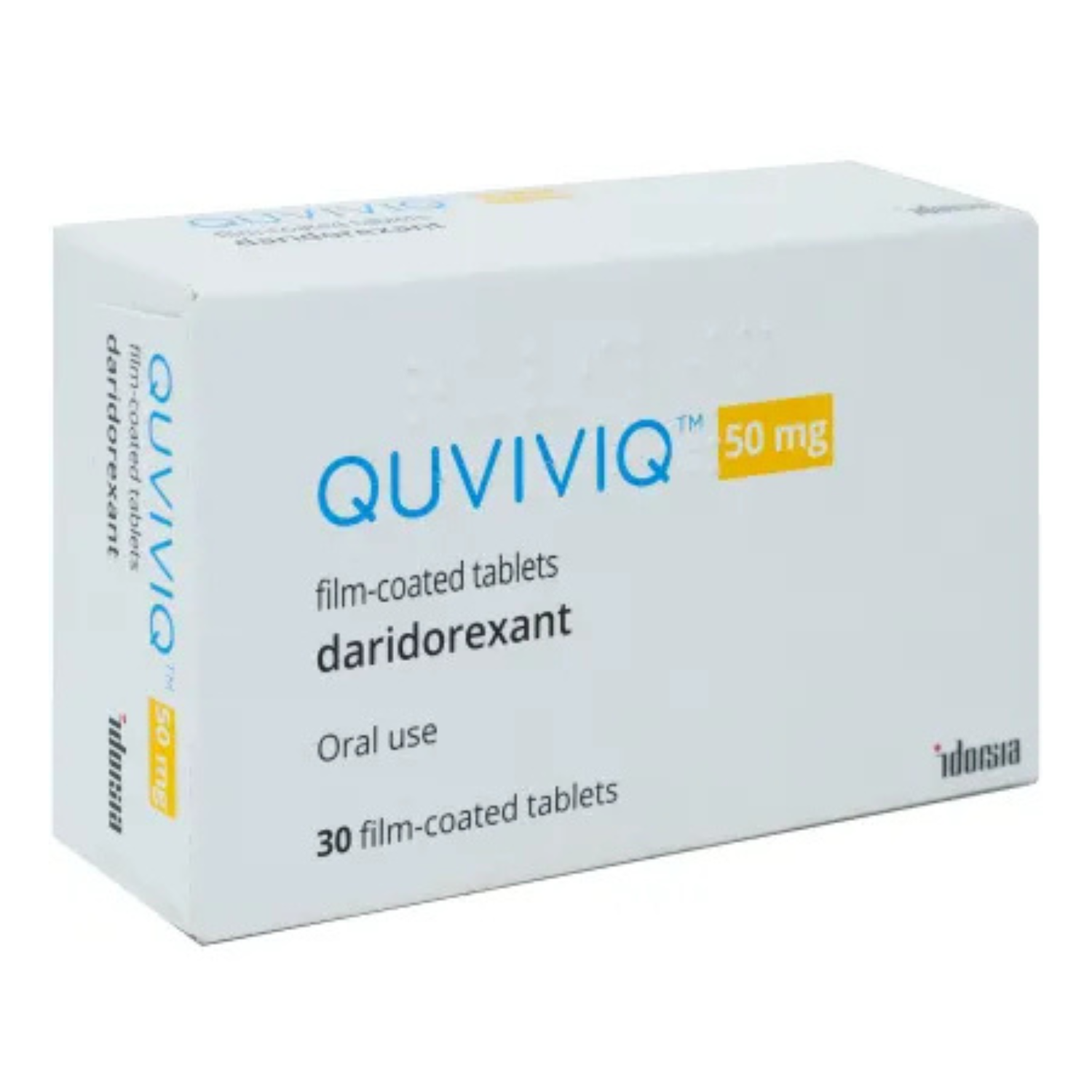
| Medication Name | Quviviq Tablets |
| Medication Form | Film-coated tablets |
| Used For | Treatment of insomnia in adults |
| Who Can Use | Adults aged 18 and over |
| Active Ingredient(s) | Daridorexant |
| Usual Dose | One tablet taken once nightly, within 30 minutes of bedtime |
| Common Side Effects | Headache, excessive sleepiness, dizziness, tiredness, nausea |
| Prescription Required | Yes |
| Patient Information Leaflet | Quviviq Tablets Patient Information Leaflet |
Quviviq is a prescription treatment for insomnia in adults. Insomnia is a sleep disorder that can make falling asleep or staying asleep difficult, often leaving people without enough restful sleep through the night.
Poor sleep can affect your concentration, energy levels, mood, and ability to function normally during the day. Some people may struggle to drift off at bedtime, while others wake frequently during the night or wake up too early in the morning.
Quviviq helps you fall asleep faster and stay asleep longer, giving you more restful nights and improving how you feel and function during the day.
Quviviq contains the active ingredient daridorexant, a dual orexin receptor antagonist. Orexin is a naturally occurring chemical in the brain that helps promote wakefulness.
Daridorexant works by blocking the action of orexin. This helps reduce wakefulness signals in the brain, making it easier to fall asleep and stay asleep through the night.
By improving sleep quality and duration, Quviviq can also help improve daytime functioning in people affected by insomnia.
Quviviq tablets are suitable for adults with chronic insomnia.
Don’t take Quviviq if you:
Speak to your doctor or pharmacist before taking Quviviq if you:
If you’re unsure if Quviviq is suitable for you, speak to a healthcare professional before starting treatment.
Quviviq can be taken with or without food, though it may take longer to work if taken with or shortly after a large meal.
The recommended dose is usually 50mg once nightly. If you have liver problems or are taking certain medicines, your doctor may prescribe a lower dose, with the 25mg tablet given instead.
If you forget to take Quviviq at bedtime, skip the missed dose and take your next tablet the following night as usual. Don’t take a dose later during the night or take two tablets to make up for a missed dose.
Treatment duration should be kept as short as possible and reviewed regularly by your doctor.
Quviviq is generally well tolerated, but like all medicines it can cause side effects, though not everyone gets them.
These may affect up to 1 in 10 people:
These may affect up to 1 in 100 people:
Speak to your doctor or pharmacist if you experience any side effects while taking Quviviq.
You can report side effects through the MHRA Yellow Card Scheme. Reporting side effects helps improve the safety information available for medicines.
Active ingredient: Daridorexant hydrochloride, equivalent to 25mg or 50mg of daridorexant per tablet
Other ingredients:
Quviviq tablets contain less than 1 mmol sodium (23mg) per tablet, which means they are essentially sodium-free.
GOOD
You should avoid drinking alcohol while taking Quviviq tablets. Alcohol can increase the sedative effects of the medicine, which may lead to increased drowsiness, dizziness, poor coordination, and a higher risk of falls or accidents.
Quviviq is a prescription only medicine in the UK, so it cannot be bought over the counter. You’ll need a prescription from a qualified prescriber before it can be dispensed.
Quviviq can affect your alertness the following morning. You should allow around 9 hours between taking your tablet and driving or operating machinery. If you still feel drowsy or not fully alert, don’t drive.
Some medicines can interact with Quviviq and affect how it works. This includes certain antifungal medicines, antibiotics, HIV treatments, cancer medicines, anxiety medicines, antidepressants, and medicines that affect the brain. Always tell your doctor or pharmacist about any medicines you are taking before starting Quviviq.
You can stop taking Quviviq without gradually reducing the dose, and there are no known harmful effects of stopping. If you’re considering stopping your medicine, it’s still a good idea to speak to your doctor first so they can review your treatment.
Weight gain isn’t a known side effect of Quviviq. If you notice unexpected weight changes while taking this medicine, speak to your doctor or pharmacist.
Current evidence suggests that Quviviq can continue to work when taken nightly as prescribed. Clinical studies have shown that daridorexant remained effective for up to 12 months of treatment, without evidence of reduced effectiveness over time in most people. Your doctor should still review your treatment regularly to make sure it’s continuing to help your insomnia symptoms.
In two large Phase 3 clinical trials in adults with insomnia, Quviviq improved sleep outcomes compared with placebo. At the 50mg dose, it also improved daytime functioning. Studies in patients with insomnia followed people for 3 months, with longer-term data showing the benefits were maintained over 12 months of nightly use.
Quviviq should be used for the shortest duration necessary. Your doctor will usually review your treatment within 3 months and periodically after that to decide if you should continue taking it.
Quviviq is considered to have a lower risk of dependence and addiction compared with older sleeping tablets such as benzodiazepines and Z-drugs like zopiclone. It works differently by blocking orexin, the brain chemical involved in wakefulness, rather than acting as a traditional sedative.
If you are pregnant, breastfeeding, think you may be pregnant, or are planning to have a baby, speak to your doctor before taking Quviviq. It isn’t known if the medicine could harm an unborn baby, and small amounts may pass into breast milk.
Quviviq is usually prescribed for adults with long-term insomnia where cognitive behavioural therapy for insomnia (CBT-I) has been tried but hasn’t worked, or where CBT-I isn’t available or suitable.
Some people may feel sleepy, tired, or less alert the next morning after taking Quviviq. This is why it’s recommended to leave around 9 hours between taking your tablet and activities such as driving or using machinery. If morning drowsiness becomes a problem, speak to your doctor or pharmacist.
Page content authored by Amjad Khan, last reviewed by Dr Hussain Ahmad on 5th September 2026.