Variety of delivery options including next day & free delivery.
Pharmacy, clinic and prescribers based in Greater Manchester.
Start your treatment with a quick and free online consultation.
Variety of delivery options including next day & free delivery.
Pharmacy, clinic and prescribers based in Greater Manchester.
Start your treatment with a quick and free online consultation.
Fill in a quick online consultation for our licensed pharmacists to review.
Our pharmacists will review your treatment to ensure it’s suitable.
Your treatment will be delivered to your door quickly & discreetly.
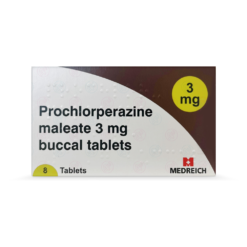
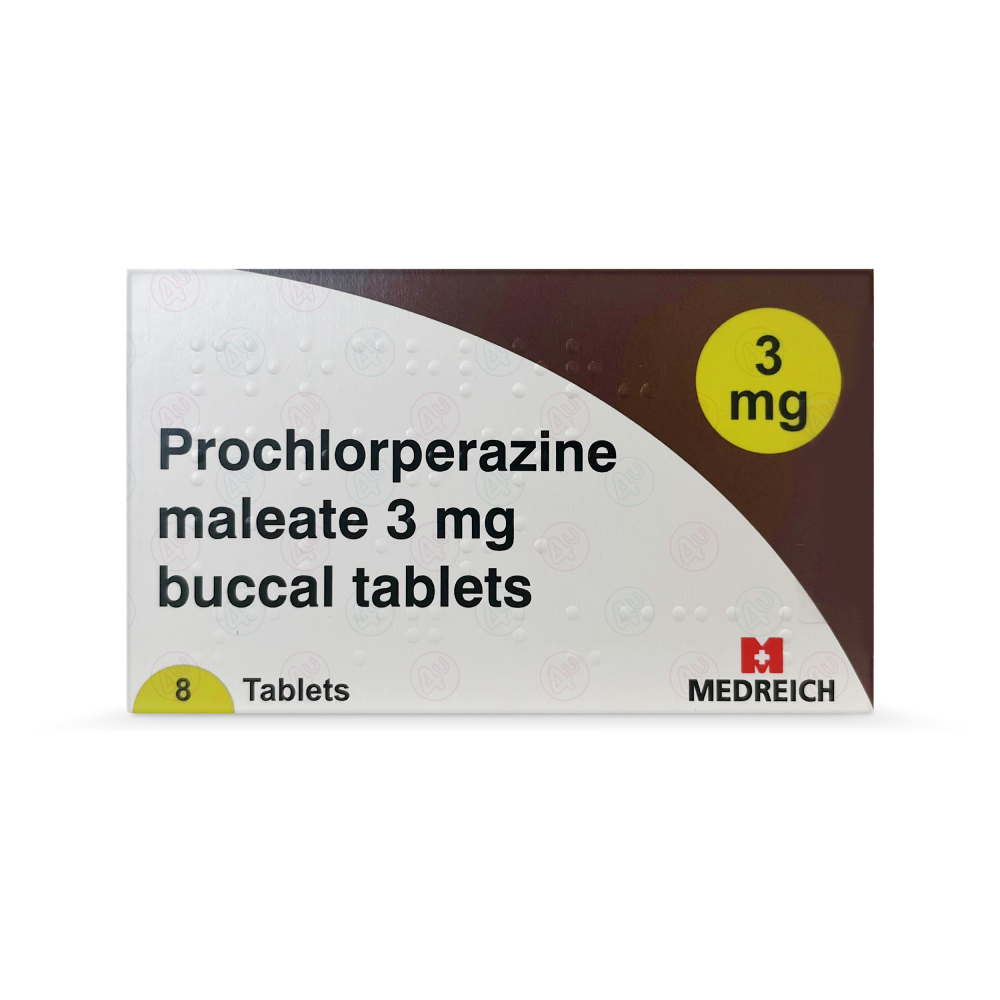
| Medication Name | Prochlorperazine Maleate 3mg Buccal Tablets |
| Medication Form | Buccal tablet |
| Used For | Treating nausea and vomiting associated with migraine |
| Who Can Use | Adults aged 18 years and over |
| Active Ingredient(s) | Prochlorperazine maleate 3mg |
| Recommended Dose | 1 to 2 tablets twice a day |
| Common Side Effects | Drowsiness, dizziness, dry mouth |
| Prescription Required | No |
| Patient Information Leaflet | Prochlorperazine Buccal Tablets Patient Information Leaflet |
Prochlorperazine 3mg buccal tablets are used to treat nausea and vomiting associated with migraines. They are sometimes referred to as Buccastem. They are available to buy from a pharmacy without a prescription.
Because the tablet dissolves against the gum rather than being swallowed, it’s absorbed directly into the bloodstream without passing through the stomach. This is useful during a migraine attack, when nausea can make it difficult to keep oral tablets down.
Prochlorperazine belongs to a group of medicines called phenothiazines. These tablets work by blocking dopamine receptors. By blocking dopamine receptors in the brain area that triggers sickness, the medicine prevents those signals from reaching the gut.
Interrupting the signals that lead to nausea and vomiting means relief comes faster. Placing the tablet against the gum means it’s absorbed through the lining of the mouth, so it gets to work without relying on your digestive system.
Prochlorperazine tablets are suitable for adults aged 18 and over who experience nausea and vomiting associated with migraines.
Don’t use prochlorperazine buccal tablets if you:
Speak to your doctor before using prochlorperazine if you:
The tablet shouldn’t be swallowed whole or chewed, as this can cause it to dissolve too quickly and reduce its absorption. This will make sure it’s used to treat your symptoms effectively.
If you wear dentures, position the tablet comfortably along the lip on the gum line.
If you forget a dose, take it as soon as you remember. Don’t take a double dose to make up for a missed one.
Like all medicines, prochlorperazine can cause side effects, though not everyone gets them.
These very rare reactions are unlikely to occur at the low dose used in this medicine.
Stop taking prochlorperazine and inform your doctor straight away if you experience:
If you notice any side effects not listed here, tell your doctor or pharmacist. You can also report them directly via the Yellow Card Scheme.
Active ingredient: Prochlorperazine maleate 3mg
Other ingredients: Sucrose, locust bean gum, xanthan gum, hypromellose 2910, riboflavin sodium phosphate, magnesium stearate and talc
GOOD
Each tablet takes 1 to 2 hours to fully dissolve. However, most people stop noticing it within a few minutes of placing it against the gum, so you don’t need to wait around for it to finish dissolving.
The tablets don’t need to be refrigerated. Store them in the original blister pack to protect them from light, and keep them out of reach of children.
No – chewing or swallowing the tablet means it won’t be absorbed properly. It needs to slowly dissolve in the mouth so the medicine can be absorbed through the gum lining. Try not to move it around with your tongue either, as this speeds up dissolving and reduces absorption.
If you swallow the tablet accidentally, it’s unlikely to work as well. The buccal route is specifically designed to absorb the medicine through the mouth lining, bypassing the stomach. This matters during a migraine, as nausea can affect how well your gut absorbs medicines. If you’re unsure what to do, speak to your pharmacist.
Yes. Check the expiry date on the outer carton before use and don’t take the tablets after that time. The expiry date refers to the last day of the month shown.
Alcohol can interact with prochlorperazine, so avoid drinking while you’re taking it.
Page content authored by Amjad Khan, last reviewed by Dr Hussain Ahmad on 17th July 2026.