Royal Mail tracked 24 or 48 hour delivery in plain, unmarked packaging.
Pharmacy, clinic and prescribers based in Greater Manchester.
Where a prescription is needed, the price you see includes your consultation and prescription.
Royal Mail tracked 24 or 48 hour delivery in plain, unmarked packaging.
Pharmacy, clinic and prescribers based in Greater Manchester.
Where a prescription is needed, the price you see includes your consultation and prescription.
Fill in a quick online consultation for our licensed pharmacists to review.
Our pharmacists will review your treatment to ensure it’s suitable.
Your treatment will be delivered to your door quickly & discreetly.
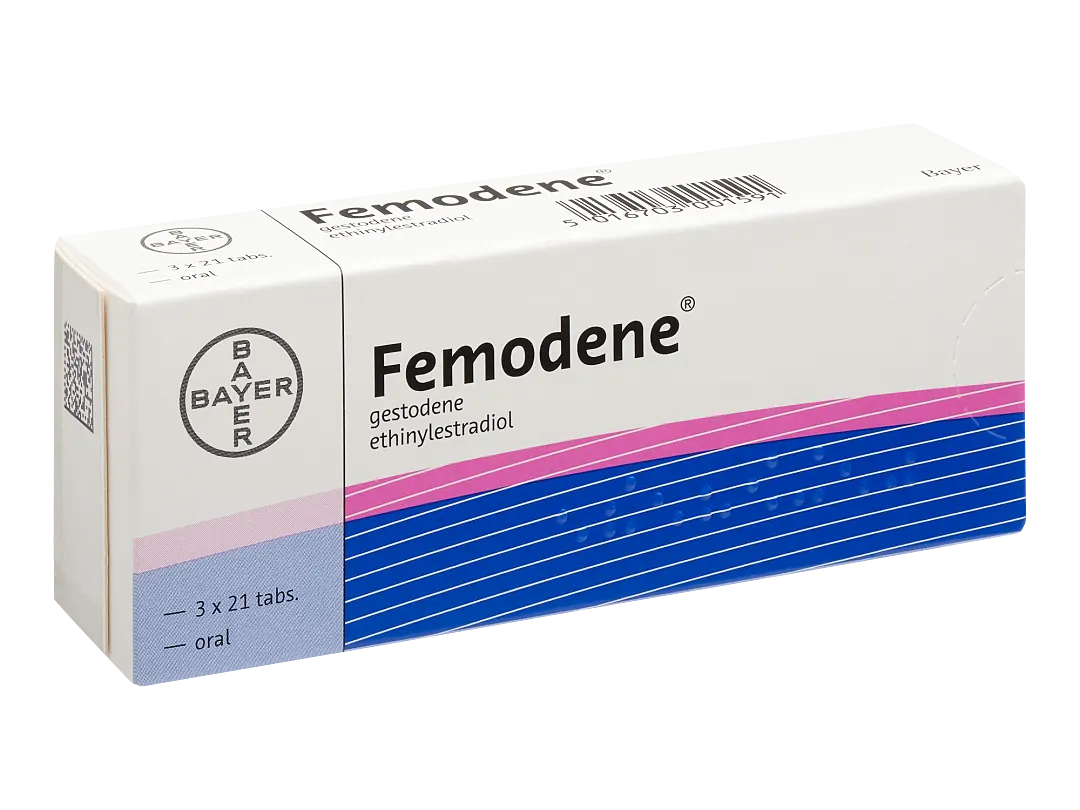
| Medication Name | Femodene Contraceptive Pill |
| Medication Form | Film-coated tablet |
| Used For | Prevention of pregnancy |
| Who Can Use | Adult women |
| Active Ingredient(s) | Gestodene 75 micrograms, ethinylestradiol 30 micrograms |
| Usual Dose | One tablet daily for 21 days, followed by a 7-day pill-free break |
| Common Side Effects | Nausea, stomach ache, headaches, mood changes, breast tenderness, weight gain |
| Prescription Required | Yes |
| Patient Information Leaflet | Femodene Patient Information Leaflet |
Femodene is a combined contraceptive pill containing two female sex hormones, oestrogen (ethinylestradiol) and progestogen (gestodene). Together, they prevent pregnancy in three ways:
Femodene won’t protect you against sexually transmitted infections such as chlamydia or HIV. Only condoms can help with this.
Femodene is suitable for adult women who need reliable contraception.
Don’t use Femodene if you:
Speak to your doctor before using Femodene if you have or have had:
When you start taking Femodene, take 1 pill daily for 21 days, following the direction of the arrows on the strip marked with a day of the week. Taking your pill at the same time each day helps maintain consistent hormone levels. Swallow it whole with water – don’t chew it.
After finishing all 21 tablets, have a 7-day pill-free break. You’ll usually have a withdrawal bleed during this time. Start your next strip after the 7 days, even if you’re still bleeding. You’re protected against pregnancy during the 7-day break, as long as you’ve taken Femodene correctly.
Like all medicines, Femodene can cause side effects, though not everyone gets them.
These may affect up to 1 in 10 people:
These may affect up to 1 in 100 people:
These may affect up to 1 in 1,000 people:
Stop taking Femodene and contact a doctor immediately if you experience signs of:
If you experience any side effects not listed here, tell your doctor or pharmacist. You can also report side effects via the MHRA Yellow Card scheme.
Active ingredients: Gestodene 75 micrograms, ethinylestradiol 30 micrograms
Other ingredients: Lactose, maize starch, povidone, magnesium stearate (E572), sodium calcium edetate, sucrose, macrogol 6000, calcium carbonate (E170), talc, montan glycol wax
Femodene contains lactose and sucrose. If you have been told you have an intolerance to some sugars, speak to your doctor before taking it.
GOOD Based on 184 reviews
 Posted on Google
 Bradley Robinson30/04/2026
 Absolutely Amazing staff! Such a help thank you so muchPosted on Google
 Samiur Rahman30/04/2026Best pharmacy in the UK. The staff here are very helpful, empathetic, understanding and compassionate. Brilliant customer service and staff are actual people who use their discretion to help people.Posted on Google
 Vivien donnellon29/04/2026Extremely efficient and knowledgeable information given. All my questions were answered and also some advise regarding the issue. Thank you RehanaPosted on Google
 james watkins22/04/2026Brilliant device ordered yesterday received it today
When taken correctly, Femodene is one of the most reliable reversible methods of contraception available – over 99% effective. Its effectiveness depends on taking it consistently and as directed – starting each new strip on time and not missing doses.
Femodene is a 21-day pill: you take one tablet daily for 21 days, then have a 7-day pill-free break. Femodene ED is an everyday version that comes in strips of 28 tablets – 21 active tablets and 7 inactive (dummy) tablets. With Femodene ED, you take a tablet every day with no break, which some women find easier to manage. Both contain the same active ingredients and work in the same way.
Femodene contains 30 micrograms of ethinylestradiol, a low-dose oestrogen formulation.
Femodene isn’t suitable for use as emergency contraception. If you need emergency contraception, speak to your pharmacist or doctor as soon as possible, as time is an important factor.
If you’re planning a pregnancy, it’s best to use another method of contraception after stopping Femodene until you’ve had a natural period. This helps your doctor or midwife accurately date a pregnancy. Stopping Femodene won’t cause any harm to you or a baby if you do conceive straight away.
Taking Femodene strips back-to-back without the usual 7-day break will delay your period (or withdrawal bleed). You can do this as a one-off or on an ongoing basis. You’ll get your withdrawal bleed at the end of the second strip. Speak to your doctor or pharmacist before trying this for the first time.
How you switch depends on which pill you’re currently taking:
In all cases, you’ll have contraceptive protection from your first Femodene tablet. If you’re unsure, speak to your doctor or pharmacist before switching.
If you forget to take Femodene and you’re less than 12 hours late, take the combined pill as soon as you remember and carry on as normal. Your protection against pregnancy won’t be affected.
If you’re more than 12 hours late with a missed pill, take it as soon as you remember, even if that means taking two in one day. You’ll need to use extra contraception, such as condoms, for the next 7 days.
If you missed tablets in the first week and had unprotected sex, speak to your doctor or pharmacist about emergency contraception.
For new starters, start taking Femodene on day 1 of your period for immediate protection.
Page content authored by Amjad Khan, last reviewed by Dr Hussain Ahmad on 27th July 2026.