If you’ve ever looked in the mirror and wondered why your face is covered in angry red bumps, you’ve probably assumed it’s just acne. But what if it’s not?
Many people spend years treating what they think is regular acne, only to find out they actually have rosacea. Or vice versa. The frustrating part is that these conditions can look surprisingly similar, but they need completely different approaches to clear up.
| Acne Vulgaris | Acne Rosacea | |
| Age of Onset | Usually teens, can continue into adulthood | Typically starts after 30 |
| Location | Face, chest, back, shoulders | Central face (cheeks, nose, chin, forehead) |
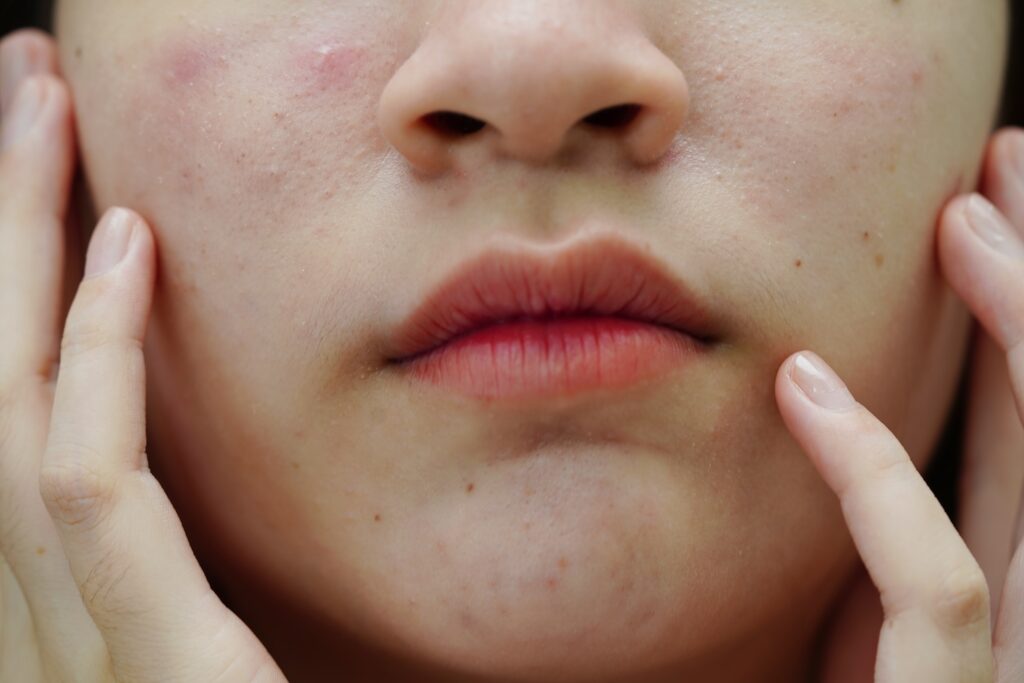
| Appearance | Blackheads, whiteheads, red bumps, cysts | Red bumps, no blackheads/whiteheads, persistent redness |
| Skin Type | Usually oily | Often sensitive, may be dry |
| Scarring | Can leave permanent scars | Rarely scars |
Rosacea is a chronic inflammatory skin condition that affects around 6% of the population. Unlike regular acne, rosacea isn’t caused by clogged pores or bacteria. Instead, it’s linked to problems with your blood vessels and possibly an overactive immune response. This is why you’ll see that persistent redness that just won’t go away, even when you don’t have active bumps.
There are four main types of rosacea:
The leading theory is that it’s a combination of genetics, an overactive immune system, and problems with the blood vessels in your face. Some research also points to microscopic mites called Demodex that live on everyone’s skin – people with rosacea seem to have more of them, or their skin reacts more strongly to them.
What we do know for sure are the triggers that can set off a flare-up:
People with rosacea may experience:
Acne vulgaris is a common skin disease that causes breakouts, affecting 1 in 4 young adults in the UK. Unlike rosacea, acne happens when your pores get clogged with oil, dead skin cells, and bacteria.
Your skin naturally produces oil to keep itself moisturised. Sometimes dead skin cells don’t shed properly and mix with this oil, creating a plug in your pore. When bacteria gets involved, you get inflammation and a pimple forms.
Unlike rosacea, we understand acne pretty well. It comes down to four main factors:
These usually present as acne breakouts in the form of:
Looking at your face in the mirror trying to figure out what’s going on? These are the dead giveaways that’ll tell you whether you’re dealing with acne or rosacea.
Acne typically starts in your teenage years when your hormones are all over the place. Some people keep dealing with it into adulthood, but it almost always begins when you’re young.
Rosacea is different. It usually doesn’t show up until you’re in your 30s or 40s. It’s more common in women, though men tend to get more severe cases.
Acne can appear anywhere there are oil glands, usually affecting the face, chest, back, and shoulders. On your face, it tends to appear in the T-zone, where your skin produces the most oil.
Rosacea stays in the centre of your face – your cheeks, nose, chin, and forehead. You won’t see it on your chest or back.
The easiest way to tell them apart is to look for blackheads and whiteheads. If you see them, it’s acne. Rosacea never causes blackheads or whiteheads.
Acne is mostly caused by what’s happening inside your body – hormones and genetics are the main factors. Stress might make it worse, but the root causes are internal.
Rosacea has clear external triggers. Most people know exactly what sets off their flare-ups – alcohol, spicy food, sun exposure, or stress.
Acne-prone skin is usually oily, especially in areas where you break out. It can typically handle various products, though some acne treatments can be drying.
Rosacea-prone skin is more sensitive. It often feels tight, dry, or burns easily. Many regular skincare products can trigger rosacea flare-ups.
Getting this wrong can worsen your skin or cause it to flare up.
For Acne:
For Rosacea:
Acne treatments focus on drying out skin and unclogging pores. Rosacea treatments work to reduce inflammation and calm the skin. Using harsh acne products on rosacea will make the redness and irritation worse.
Now that you know which condition you’re dealing with, it’s time to get the right treatment. Click2Pharmacy makes it simple to get prescription treatments for both acne and rosacea without the wait.
Our qualified prescribers can assess your skin through our online consultation and prescribe effective treatments for your specific needs.
We offer prescription treatments for:
Complete our online consultation, upload photos of your skin, and get the right prescription treatment delivered to your door.